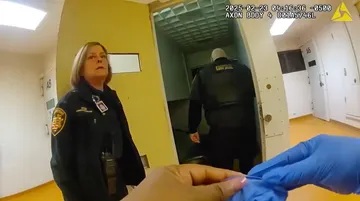
When Alan Lancaster died in January 2023 at South Central Correctional Center in Licking, Missouri, his family went looking for answers.
The Missouri Department of Corrections recorded his death as an accident and offered few additional details. His family requested records from the prison’s investigation into his death, documents such as the internal investigative report that might paint a fuller picture of Lancaster’s last moments. But their requests for more information were “largely ignored,” according to their lawyer, Joe Allen.
It wasn’t until they reached out to the county coroner who handled Lancaster’s body that his family learned the 39-year-old had been in a restrictive housing unit for over two weeks when he died from a fentanyl overdose.
In March, Lancaster’s mother, Mary Harris, filed a wrongful death suit against the prison system. The coroner’s records, including a death certificate ruling Lancaster’s death a homicide, provided the basis for Harris’ lawsuit alleging that prison officials failed to properly care for her son.
“Alan was in solitary confinement and somehow dies of a fentanyl overdose,” Allen said. “How do you get fentanyl while you're in solitary confinement?”
When someone dies in a Missouri prison, the prison system is required to provide certain information to families about the death. Staff should notify emergency contacts of the death and explain how to access the deceased’s medical records, according to the Missouri DOC’s communications director. For more information, families or their attorneys can submit records requests. State law dictates that even if certain records are normally closed, the DOC should provide families access to those documents “for purposes of investigation.”
But families of people who died in prison and their attorneys told The Marshall Project - St. Louis that the DOC doesn’t always follow its own policies. Left with unanswered questions about how their loved ones died, some have instead turned to the coroner. While coroners are elected officials generally responsible for investigating violent or unexpected deaths in their county, Missouri’s statute requires coroners to “fully investigate the essential facts” surrounding every death in custody, regardless of how it happened. The information from their investigations can help families find a sense of closure — and when deaths are suspected to be the result of abuse or neglect, a coroner’s investigation can also play a role in holding the prison system accountable.
Unlike states such as New York that have medical boards to review deaths behind bars and mandate policy changes, coroners provide the only guarantee of outside scrutiny when someone dies in a Missouri prison. And although people who die in custody each year are particularly vulnerable to disappearing from public record, the statutes governing exactly how coroners conduct their investigations contain almost no record-keeping requirements.
Historically, these policies have granted coroners wide discretion in how thoroughly to investigate, resulting in an uneven standard of prison death investigations across the state.
Now, in Missouri and across the country, a coalition of forensic scientists, public health researchers and legal experts is pushing for more robust policy and oversight to hold every prison death investigator to the same high bar.
“The coroner really is, in many places, the only opportunity for outside review or oversight,” said Dr. Roger Mitchell, president of the National Medical Association and co-author of the book “Death in Custody.” “So states need to take control over their death investigation apparatus, ensuring that there's uniformity.”
When Tanekka Guest’s husband, Christopher, died at South Central prison in October 2023, she struggled to learn the truth about his death from prison officials. All the warden told her when he broke the news was that her husband died in his sleep, Guest said.
“I was like, ‘How? What happened?’” she recalled. “The warden just said, ‘I’ll let you know more information when we get it.’”
Guest said she called the prison nearly every day for a month to speak to the warden, but he was never available. Eventually, she spoke to an investigator, who told her she would receive a flash drive with the contents of her husband’s tablet. Neither the flash drive nor the information she was promised ever came, she said.
“They said they would let me know when they had the cause of death — they never did that, never told me any information,” she added. “It was just one pushback after another.”
Details about her husband’s cause of death ultimately came from the county coroner, who called Guest to explain what happened: After a period of suicidal ideation, her husband overdosed on fentanyl and died. Guest said the biggest difference between her communication with the coroner and the prison was the follow-up. For weeks, Guest said she called the prison and never received any details. But every time she called the coroner, she got an answer. If she left a voicemail, it was promptly returned.
“Talking to her was so comforting because she kept it 100% honest,” Guest said. “She said everything she could to put your heart and mind at ease.”
Karen Pojmann, the DOC’s communications director, said the prison system “doesn’t withhold death information from families.” Autopsy reports, conducted by the medical examiner, are available to anyone who requests them, she said. Reports from the department’s internal death investigations are technically open to the public, but Pojmann said they can be closed or heavily redacted “for a variety of reasons, including … sensitive information that could compromise the security of the facility.”
Although no agency or department keeps an official count, there are numerous reported instances of families filing lawsuits in recent years against the Missouri Department of Corrections to try to get information about the deceased’s final moments in prison. Families in Missouri describe being repeatedly stonewalled by prison officials.
In one instance, an appeals court ordered the DOC to pay a mother over $60,000 in penalties and court fees for failing to provide video footage and the prison’s internal investigation of her son’s suicide in 2021. In another case, a court ordered the DOC to pay $5,000 after ruling that officials “knowingly and purposefully violated” public records law by refusing to provide video and other investigative records to another woman whose son was beaten to death in prison that same year.
“They don’t hear back from the Department of Corrections, or they’ll deny a lot of records requests,” said Lori Curry, executive director of the advocacy group Missouri Prison Reform, of families’ experiences with the prison system. “It can really break your spirit to try to find out the truth about something and continually run into brick walls.”
The coroner's independence from the prison system can mean they are emboldened to be direct and honest with families about how someone died, death in custody researchers noted. Coroners have the ability to freely hand over information like autopsy reports and death certificates. By contrast, limited oversight and the risk of being held legally liable for a death behind bars creates an incentive for prison officials to either cover up or misattribute causes of death.
After Christopher Scroggins died at South Central in June 2022 at the age of 23, the Department of Corrections listed his manner of death as “unknown.” But when an attorney representing the family requested the coroner’s records, he learned that Scroggins’ death was actually due to a fentanyl overdose.
The attorney, Geoff Meyerkord, said he wasn’t afraid to sue the DOC for more details if necessary, despite facing what he described as considerable pushback and roadblocks. But protracted litigation, and having to relive the death again and again, can be a significant emotional burden for families, he said. Particularly for families who are just looking to answer basic questions about their loved one’s death, it’s often just easier to ask the coroner.
“We always want to take the path of least resistance if we can,” he said.
When families do choose to file a lawsuit against the prison for a wrongful or preventable death, experts say coroner records can be critical to building a case. In Lancaster’s case, the family’s repeated attempts to get records from prison officials or from the DOC went unanswered. “All the agencies have collectively failed and refused to comply with the law and produce the requested documents, conspiring to and engaging in a cover-up,” the complaint states, causing the family “extreme mental and emotional pain, suffering and anguish.”
By contrast, the coroner’s report was provided without protest and offered crucial details, including that a corrections officer was reportedly “fired over the episode” two days after Lancaster died.
“Lancaster was murdered while in the custody and care of MDOC,” the complaint alleges. “The Department of Corrections … abjectly failed in their duty of care to Lancaster, resulting in his preventable homicide.”
The lawyer for Lancaster’s family noted he “ would not have made that specific statement without some supporting information.”
Improving record-keeping is especially valuable for deaths in custody, said Marie Lasater, the former Texas County coroner who investigated the deaths of both Lancaster and Guest. When a death occurs behind prison walls, families rarely see or even speak with their loved one in their last moments, and don’t have immediate access to the basic information they otherwise would about how the person died. If a death was preventable, prisons may make it difficult for families to ever find out, Lasater noted. For this reason, she added, incarcerated people need more of an investigation than a death in the free world.
“There's a lot more possibility for a prison death to be reported [as] something other than what it was,” she said.
After Howard County Coroner Trisha Clark moved back to Missouri from Florida just before the pandemic, she said she was shocked by some of her peers’ practices. Rather than coroners, Florida’s system for death investigations relies on medical examiners, who are required by statute to keep duplicate copies of records, including autopsy reports and lab investigations. Florida also has a guide to record-keeping, and a commission whose job it is to ensure “uniform standards of excellence.” In Missouri, no such guardrails exist.
Clark also works as a forensic investigator for Boone County, home to the minimum security Fulton Reception and Diagnostic Center, where five people died last year. She said many of Missouri's newer coroners understand the importance of investigating prison deaths thoroughly and independently, rather than simply rubber-stamping the prison’s version of events. Still, it’s a challenge to get coroners in every county on board without some minimum standard of record-keeping.
“You have coroners that literally have a pocket notebook where they're writing a name and a date of birth,” she said. “These families are not getting a full, thorough investigation because [the coroner] is just like, ‘Oh well, whatever.’”
Nationally, legal and medical researchers, as well as forensic scientists, are pushing to reform the investigative system for deaths in custody. The goal, they say, is to improve public understanding of how deaths happen and reduce the number of preventable deaths. In a recent report, the National Academies of Science, Engineering and Medicine recommended that states require licensing for anyone performing prison death investigations, as well as an annual peer review for all coroner and medical examiner’s offices of at least 10% of their cases. The report also recommended the federal government update its death certificate template to include a checkbox for deaths in custody.
Experts say there are several simple measures Missouri could take to improve the investigative process for people who die in prison, starting with clarifying expectations. State policy instructs coroners to investigate, but doesn’t say much about what that investigation should look like. Coroners can choose to talk to witnesses, or not, and there is no requirement for digitization of records.
Ensuring transparency around prison deaths would require the state to create new standards, noted Aaron Littman, co-lead of UCLA Law's Behind Bars Data Project. Those standards might stipulate how quickly prison death investigations must be completed, what data must be collected from the prison, and how much of it must be public or made available to families.
State legislators could standardize record-keeping by mandating all coroners and medical examiners use the same software and reporting systems, experts added. (The former head of Missouri’s Coroners and Medical Examiners Association told The Marshall Project - St. Louis he’s in the early stages of proposing a bill to do just that.) Policymakers could also require the public health system to update the state’s death certificate form with a clear designation for in-custody deaths, researchers noted, so the public isn’t reliant entirely on the criminal justice system to track and report deaths. Missouri’s Department of Mental Health has a fatality review panel tasked with assessing “all suspicious deaths” of adults in the department’s custody; researchers pointed out that the state could create a similar panel for prison deaths.
To grieving families, a coroner’s ability to be a resource in the face of an opaque prison system can mean not only accountability for their loved one’s death, but also closure. Coroners noted that improving the standard of reporting would offer all families an equal chance to understand what happened, eliminating the speculation and uncertainty that can exacerbate their grief and suffering.
For weeks after her husband’s death, Tanekka Guest clung to a fading hope that prison officials would provide any information about Christopher’s final moments. She said the only detail the warden shared — that Christopher died in his sleep — left her with more doubt and questions: Was he alone? What could have killed him so suddenly? When she heard a rumor from another incarcerated person about foul play in her husband’s death, she said it nearly broke her.
After going weeks without answers, Guest said the coroner gave her the information she needed to properly grieve. At last, she said, she could rest.
“I couldn’t believe it at first,” Guest said. “But that’s how I was finally able to get closer to him: knowing what happened.”
Correction: A previous version of this story contained a misspelling of attorney Geoff Meyerkord’s last name.