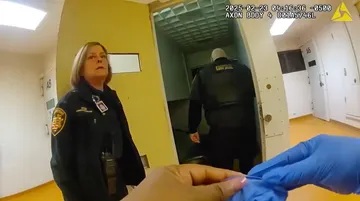
At least 60 people arrested in Hinds County have been jailed in its detention facilities for over three months — including at least five for more than a year — with no indictment filed against them and no pathway to a trial in sight.
One man has been in jail for 18 months on drug charges without an indictment and has no attorney to move his case along, according to court records reviewed by The Marshall Project - Jackson.
Mississippi is one of the few states where people can be jailed indefinitely without indictment, a critical step to send a case to a judge or a jury. This gap has deepened the overcrowding, violence and dysfunction that put Raymond Detention Center — the county’s primary jail — under federal control in the first place.
The lengthy detentions in Hinds County have been caused by multiple issues, including an increased Capitol Police force in Jackson, an overwhelmed state crime lab, and a shortage of prosecutors and public defenders to handle the backlog of cases.
The federal receiver operating the Raymond Detention Center has warned the county district attorney that the jail cannot be fixed while people remain locked up without a way to get to court.
In a letter obtained by The Marshall Project - Jackson, federal receiver Wendell M. France wrote to Hinds County District Attorney Jody Owens telling him that holding so many people is costly for county taxpayers and is impeding France’s ability to fix the jail’s problems. France, who took over the jail on Oct. 1, asked Owens to address the delays in prosecution immediately.
“Overcrowding affects housing, safety, and services,” France wrote. “Staff and funding that should be directed toward facility improvements are instead consumed managing extended pretrial stays.”
As part of the court’s receivership agreement, France is barred from making public statements about his work.
More than half of the unindicted detainees were arrested on violent crime charges, including rape, murder and aggravated assault. Others were charged with nonviolent offenses, including burglary and drug possession.
One detainee, LaDarius Moore, was arrested more than six months ago and is being held on a $7.5 million bond, one of the highest in the county’s history. As of Dec. 1, he has not been indicted.
In a handwritten note to Judge Debra Gibbs, Moore asked for his day in court. “I have lost my job after being in here for 6 months. My kids mother can’t afford to feed them without SNAP benefits on her own and they really need me to take care of them. I respectfully ask you to consider my family responsibilities.”
Moore faces charges of aggravated assault, being a felon in possession of a firearm, and 12 counts of armed robbery. His court file shows no response from the judge and no upcoming court date.
Hinds County’s indictment delays reflect a statewide problem, said André de Gruy, the state public defender. The Marshall Project - Jackson previously reported on a case in Pike County, in which a man was incarcerated for nearly 18 months before being indicted.
A federal judge appointed France in 2022 after the county repeatedly failed to comply with a Justice Department agreement to address rampant violence, understaffing, a steady flow of drugs into the facility, and poor record-keeping that kept detainees there long past their court-ordered release dates. Appeals delayed France’s start until this October.
More than a decade after the Justice Department first brought its case, reports of inhumane conditions still abound. Detainees at Raymond reported living in darkness, being extorted to use the restrooms and sleeping on filthy floors. Earlier this year, a man was killed inside the jail and two others died of drug overdoses. In October, the Hinds County Board of Supervisors approved an emergency declaration because of overcrowding at the facility, which held about 450 people at the beginning of that month.
“You’re risking life and limb in the Hinds County jail. That is a serious proposition of someone who hasn’t been indicted of any crime, much less convicted,” said Hernandez D. Stroud, a senior fellow in the Justice Program at the Brennan Center for Justice at New York University, who has studied jail receivership. “That’s scary.”
Typically, after a person is arrested, law enforcement turns the case over to the district attorney, who brings the case before a grand jury. If the grand jury returns an indictment — a formal criminal charge — the case moves to a judge and potentially a jury.
Already burdened with a backlog of cases, the county’s legal system has been inundated with arrests since the Capitol Police began expanding in July 2021, in response to what Gov. Tate Reeves called a “never-ending cycle of violent crime.” The Capitol Police force previously guarded state property, but its jurisdiction, the Capitol Complex Improvement District, has since grown to more than 20 square miles in the city. The force has also grown from 81 officers in 2021 to more than 150. By the end of 2023, the number of indictments had risen 33% from the previous year.
A receiver is “not going to be able to address those problems until you reduce the population to be more in line with the staffing levels you have, and the bed capacity,” de Gruy said. “Trying to do that in an environment where you’re now seeing a lot more people being arrested, it just makes his job that much harder.”
Lengthy waits for case files from arresting agencies and reports from an overwhelmed crime lab also drag cases out, said de Gruy.
In response to France’s letter, Owens wrote that he had not received case files from law enforcement on more than 100 of the approximately 240 unindicted detainees, including those held for more than three months. He also cited delays in receiving final autopsy reports, a need for mental health evaluations of defendants and “the sheer volume of crime plaguing our community.”
Owens’ office indicted 1,264 cases last year and resolved 1,135, leaving 129 open. The previous year, grand juries returned indictments in 1,696 cases and his office resolved just 989. Cases are resolved by guilty pleas, trials, dismissals or pretrial diversion programs.
Owens also told France that the jail roster contained misspelled names and outdated information. In some cases, people listed as unindicted had already been indicted or released.
“This just has layers of institutional incompetence and dysfunction, such that even when you have a receiver, it is hard to disentangle everything to get to the constitutional violations,” Stroud said. “It’s stunning.”
Hinds County Sheriff Tyree Jones, who used to run the jail and also serves as the Jackson Police chief, said he was not aware of any delays in forwarding cases to prosecutors.
“When it comes to the jail, I think everybody has their own individual opinion, and everybody has their own professional responsibility,” Jones said. “There’s probably a little bit more room for correction on all levels.”
Owens and Hinds County Public Defender Gail Wright Lowery have asked the county Board of Supervisors for $700,000 in emergency funds, split between their offices, to fund six to eight staff members to focus on reducing the jail population.
“The only way the system works is that … as many people are getting out of our system as fast as we’re bringing them in,” Owens said at the Nov. 3 board meeting. “Our current volume doesn’t allow us to do that.”
Wright Lowery said five attorneys have recently left her office. She requested the funds to boost her staff’s salaries and to hire experienced attorneys to work part-time to help move cases through the system.
“Every time I lose an attorney, you have an average of over 100 people in detention who lose their attorney,” she said. Her office is funded for 14 lawyers.
Hinds County Board of Supervisors President Robert Graham said the board would consider the request for the $700,000.