The St. Louis jails are nearing a breaking point.
At the St. Louis City Justice Center, people behind bars have complained of going weeks without showers and months without fresh air or direct sunlight. One incarcerated person described how swiftly fights can break out without staff present. At the St. Louis County Jail, a former corrections officer said women detainees have bled through their clothes onto the floor because no one provided pads or tampons during their periods. Several people have attempted suicide, the officer added, including one man who was just minutes away from hanging himself from a ceiling vent by a bedsheet before officers intervened.
The situation inside the county jail is so bad that it failed an inspection by the American Correctional Association, an organization that critics say has rubber-stamped dangerous facilities. The preliminary audit cited overcrowding and understaffing as among the jail’s major issues.
Both currently and previously incarcerated people, and current or former officers at both jails, told The Marshall Project - St. Louis that staffing shortages are endangering the health and safety of officers and residents alike. The jails are short between one-quarter and one-half the expected number of officers. As a result, detainees’ basic needs are ignored, emergency medical response is delayed, and staff are pushed to their limits. The situation is dire, said former city and county jail administrator Doug Burris.
“The culture at the Justice Center is one of regularly being overwhelmed because of the lack of correctional officer staffing available to operate the facility safely,” Burris wrote in his operational review of the city jail in January. “There is a need for officers to be available to respond to an emergency literally every minute of the day.”
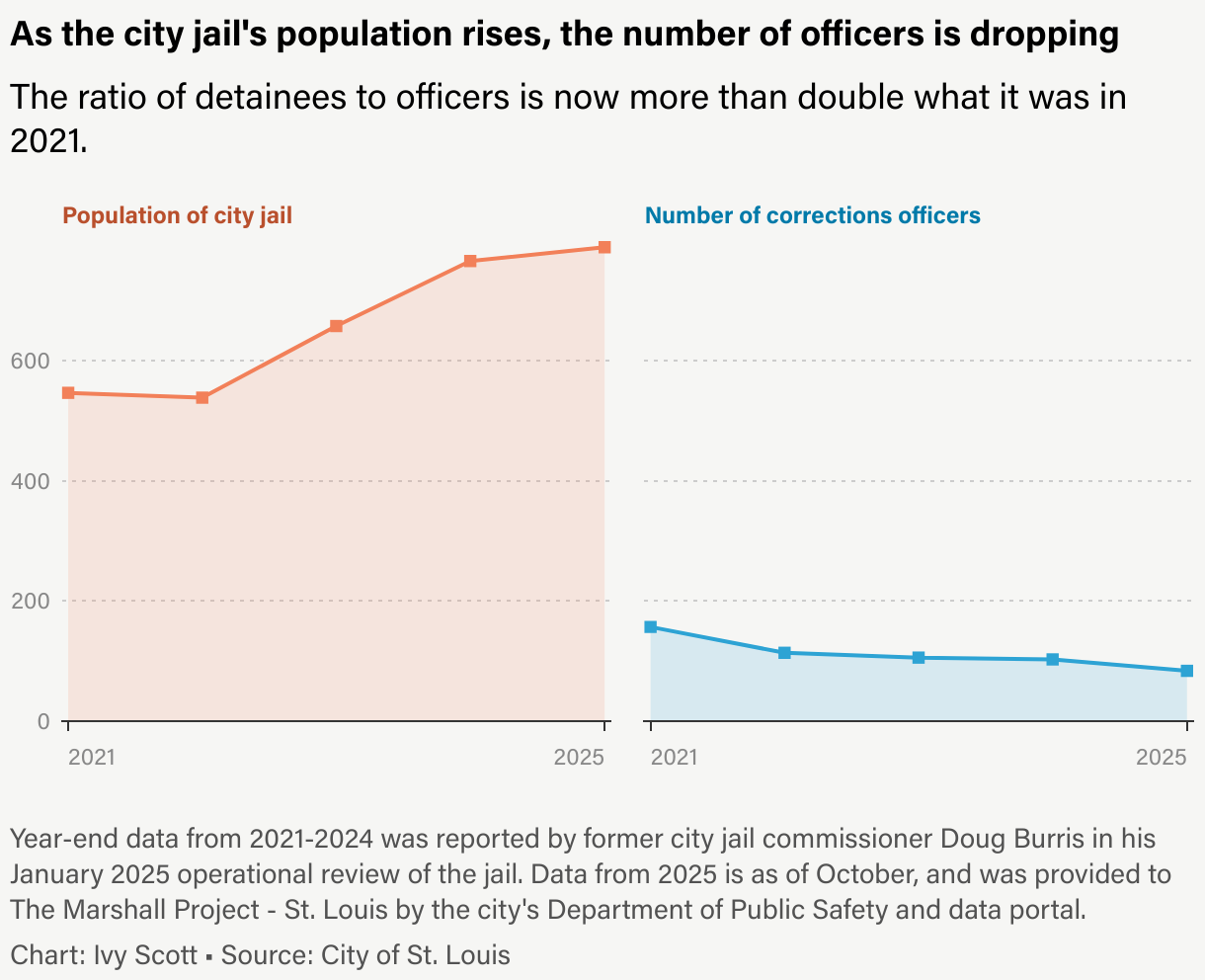
The current crisis began during the COVID-19 pandemic, when the city jail experienced a sharp drop in staffing while the jail population rose. Officer employment decreased by 32% between 2021 and 2024, as the incarcerated population climbed by 40% in that same three-year period. Corrections officers at the city jail said the health risk of interacting with hundreds of people a day, without the additional pay other essential workers received, drove many people away.
“I’ve been working since 2019, through the trenches. I was in here every single day until it was over, and I'm still coming in here,” Officer Nikie Edwards said. “Give us our hazard pay.”
At the slightly larger county jail, the population and staffing trends are similar, according to Nate Hayward, who worked more than three decades at the county jail until becoming the city jail’s newest commissioner earlier this year. As of the September audit, the jail’s population had climbed to 1,340 people — more than 100 detainees above its rated capacity — while the number of full-time staff dropped to 269, from an average of 362 employees last year.
“We were short big-time in St. Louis County,” he told The Marshall Project - St. Louis in a September interview, noting that the county was down at least 70 officers when he left. “We made it work, but it’s a big issue there, just like in the city.”
Both St. Louis city and county have tried to grow their ranks by lowering the minimum age necessary to become a correctional officer. At the county jail, applicants were required to be at least 21 years old to work there until 2021; on current applications, that age restriction no longer exists. At the city jail, the minimum age is 19.
While this range is standard among prisons and jails across the country, and mirrors a similar loosening of the age requirement at the state prison level, administrators said hiring teenagers has only created new problems.
According to Hayward and other current staff, young officers rarely last at the jails. They are often unable to control their tempers when provoked by people behind bars and fail to keep calm under pressure, staff said. Conversely, the teenagers are also easily influenced by their peers and by older detainees, and frequently get in trouble for showing preferential treatment or choosing not to enforce policies for the detainees they prefer.
The swift termination of young officers contributes to an already high turnover rate, officers said. A large share of newly hired officers quit their jobs within 180 days of starting, Burris noted in his January report of the city jail. Current officers attribute the attrition to the long and often demanding shifts, where they are expected to perform the duties of multiple officers on their own.
And as staff numbers dwindle, a vicious cycle intensifies.
“A lot of the issues come from not having staff, and a lot of the staff don't want to stay because of the issues,” said Trey Lodge, the city jail’s security chief. “It's like we can't get out of that cycle.”
For corrections officers, issues range from having to sacrifice meals and breaks to mandatory overtime, they said, which grates away at their mental health, causing some officers to snap and others to grow apathetic to bleak living conditions for people in jail. And for people incarcerated at both jails, understaffing means their rights are violated when access to essential services like showers, soap, and phone calls is denied, while medical and mental health conditions are often ignored until they become deadly.
“I’ve worked 12-hour shifts by myself,” said Ushma Michel, a former corrections officer at the St. Louis County jail who said she was hired in late 2024 and quit in July.
“I had to, because overnight it would just be one of us handling 200 inmates,” she said. “If you had an emergency, which I did, it took the lieutenant five minutes to get there. By that time, the individual could have passed away.”
Near the end of her time at the county jail, Michel said two people tried to kill themselves within the same week: one by drug overdose, and one by attempted hanging. According to the audit, the jail is short 74 officers, making it difficult for the facility to meet the mandated two-officer minimum per housing unit. When an officer is working a wing of the jail alone, Michel said, they must be constantly roving the floor and checking for signs of life in every cell, hoping nothing goes wrong in another unit — or if it does, that someone gets there in time.
“These walks are so important… the thing is, no one wants to do them because they’re exhausted,” she said. “But if you're not doing your job, then someone's gonna die.”
A consequence of long hours and low morale, Michel said, is that meeting detainees' basic needs becomes a low priority for some officers. She recalled putting in a request to a lieutenant for a new pair of underwear for a woman on her period. When she returned to work later that week, she found out the woman had been stuck in the same bloody undergarments for over a day, until they became so unusable that her cellmate offered to share her extra pair.
In the jail’s audit, inspectors reported that 28 people were diagnosed last year with hygiene-related illnesses or conditions, such as scabies or fungal infections.
“They shouldn't have to wait three days to get toilet paper, or two days to get pads,” Michel said. “When I left, I had inmates that were literally sobbing because I was the only one that made sure they had pads, or toilet paper, or a toothbrush.”
At the city jail, violence and neglect of medical emergencies pose a threat to both staff and incarcerated people. In November, a detainee was charged with beating a corrections officer unconscious. Incidents like these are part of a pattern of behavior that Burris said “is making the jail unsafe and destroying staff morale.” The beating came only a week after a man in his 50s was found unresponsive at the jail due to an unidentified medical emergency, marking the jail’s third death this year.
Charl Howard, who has been waiting since March for his trial on assault and trespassing charges, said he’s become increasingly fearful about what the officer shortage means for his safety, and the safety of others inside. Last fiscal year, the city reportedly employed 84 corrections officers out of a budgeted 226. Department of Public Safety spokeswoman Jamella Brown said the number of officers held steady this fiscal year, but the budget now only supports 161 officers to work with the nearly 800 detainees at the jail.
In June, Howard recalled a fight that broke out when his unit was left unsupervised for nearly an hour. In the absence of any staff, he said, “guys know they’ll have a chance to fight” with impunity. Howard said he watched from his cell as two men let out of their cells began to brawl, until one detainee flung the other from the top tier of the housing unit onto the floor below.
“The guy got up, shook it off, and they fought some more. He limps now,” Howard said. “But it was like 30 to 45 minutes before a CO showed up. There was enough time to clean up the blood on the tables and floor of the day room. By the time the officer came in, it was hush-hush again.”
The panic buttons in the cells also don’t work, Howard noted, which makes it challenging to alert an officer when there’s a fight or other urgent issue. If someone is having a medical emergency, he said, detainees are forced to kick the doors and scream to get someone’s attention.
Corrections officers from both the city and county detailed the steps they believe the jail’s leadership — the commissioner or director, and other administrators — could take to hire and retain more employees. At the top of the list are better pay and greater investment in the essential resources that benefit both staff and detainees. These two fixes could help to change the perception of what it’s like to work at the local jail, they said.
The county jail’s starting salary is just shy of $44,000. At the city jail, meanwhile, starting salaries range from about $47,000 to nearly $54,000, with a potential bonus of $3,500 for officers who complete their probationary period.
“There could be more money across the board,” said Edwards, the city jail officer. “There are people who say, ‘You could pay me a million dollars, and I wouldn't do corrections.’ But we’re doing it, so pay us what we’re worth.”
Other officers cited a need for more cleaning supplies, a mentorship program and a stronger presence at job fairs and recruitment events. Officers are eager to increase educational opportunities and other resources for people in jail, they said, but those programs are impossible to run without hiring more employees.
Hayward, the city jail commissioner, said finding new ways to improve recruitment and retention is among his top priorities. Candidates are interviewed steadily throughout the year, and so finding people who are the right fit for the job to reduce turnover is the next step. The city’s Division of Corrections held its first-ever job fair to recruit new officers in October, and Hayward said he would also consider increasing bonuses for new officers who perform well during their first few months on the job. (He also acknowledged that he was not opposed to poaching some of the county’s more experienced officers.)
The county jail’s interim director, Jonel Coleman, said pay is the biggest barrier to recruitment and retention. Coleman said the top priority needs to be offering more competitive salaries, and that she was also looking into launching a “staff wellness program” focused on addressing stress and burnout. Regarding deteriorating conditions, she stated that she was not aware of, and does not condone, forcing a female resident to stay in bloody underwear. She also said that suicide attempts “are common in jail,” but that officers’ responses to these situations have saved lives.
However, a coalition of community organizers is pushing for a greater focus on reducing the population of both jails, rather than hiring more officers. In his operational review, Burris warned of an “alarming” increase in population in recent years and acknowledged that the jail is “incapable of sustaining this kind of continued growth.” The county jail’s audit cited similar concerns with overcrowding.
Michel, the former corrections officer, said the county jail’s problems stem from leadership’s willful ignorance of fundamental health and safety issues, choosing to spend the department’s money on luxuries instead of necessities.
“We got them gym equipment,” she said, “but my inmate hasn’t had a shower in three days.”
The jails’ audit noted that the facility is suffering a crisis of leadership, with different people cycling through multiple top administrator positions in just the short time the audit was conducted. The numerous vacancies, and lack of experience from those who have just started their jobs, have undoubtedly contributed to the jail’s lack of direction and high turnover, the report noted.
In an open letter sent to the American Correctional Association over the summer, Michel asked the association to launch an independent investigation into workplace safety and staffing levels at the jail (in addition to the routine inspection and audit conducted in September).
“These issues have escalated to a point that threatens the safety, dignity, and legal rights of both staff and inmates,” she wrote. “The [county’s] Department of Justice Services is hemorrhaging skilled, dedicated professionals because those in power have failed to protect them. The consequences of inaction are not theoretical — they are immediate, measurable, and dangerous.”
According to Michel, the correctional association has yet to respond.