LIBERTY, Mo. — Fresh out of jail in New York, Carl Henry Louis jumped on a bus, yearning to see a world beyond the Big Apple and his past. During his journey, he lived on the streets, taking odd jobs, sometimes getting into trouble, even serving time behind bars again. But he always found his way back on the road.
Then he threatened a cashier and swiped a handful of cigarette lighters in Kansas City in 2021. Landing at the Clay County jail, Louis became angry and afraid, questioning why he was being held. To the detention officers, he just didn’t fit in. Whatever was going on in his mind, they were ill-equipped to handle it.
Within weeks, the problems began. Louis scooped a handful of water from the toilet and threw it at an officer handing out food trays. They wrote him up and locked him down. A few weeks later, they said, he took swings and hit an officer in the arm during a hallway pat-down search. They dropped him to the floor. As he resisted their efforts to put him in handcuffs, an officer repeatedly punched him in the belly. A swarm of others helped cinch him into a restraint chair.
Carl Henry Louis, the wanderer, was stuck.
Soon, it became clear that the jail staff was, too.
Over the past decade, jailers in Missouri have increasingly become caregivers of last resort for vulnerable people like Louis, who had a history of untreated schizophrenia. Some are released on bond back into the community for treatment. But the rest are supposed to be held at one of three secure state psychiatric hospitals where they can get therapy and medication until they can better understand the charges against them and assist in their own defense.
Instead, with treatment beds unavailable, they are forced to wait in jails that can struggle to meet basic needs like food and hygiene.
A Marshall Project review of incident reports at the Clay County jail, videos of officers pulling detainees out of their cells, internal emails and interviews with staff and Louis himself provide a rare look inside a facility dealing with a growing crisis that the state mental health agency and lawmakers have failed to solve. They also show how a program lawmakers set up to help isn’t reaching the most serious cases.
“It frustrates me to no end, when we're trying to get these individuals into a facility — a bed to get medically engaged so they can have their day in court,” Sheriff Will Akin said. “I don't want anything to happen to them, but the longer they're here, I feel like the odds go against them. The odds go against us.”
Missouri is among a group of states that have been sued by pretrial detainees for allegedly failing to provide timely evaluations and competency restoration services. Over the last decade, the problem has grown, going from 27 waiting for treatment in 2016 to 549 people in July of this year. At least two have died in jails since May 2025, including one in July. These numbers don’t include those waiting to be evaluated, who have also increased dramatically.
The state says some are “acutely ill” and most are not on medication. The longer they go untreated, the harder it can be to restore them. “It’s disgusting for anybody to be caged but especially for someone who is incompetent,” said Kerina Ibarra, a former state public defender, noting that their condition can worsen on the inside. “People can decompensate.”
What happened with Louis and the jail across four years stands as a cautionary tale about the dangers that an overwhelmed system poses to defendants and jail staff alike.
Getting stuck
Louis, who is in his 40s, spent part of his childhood growing up in south Florida before moving to New York, where he was often unhoused as a young adult. For a long time, he floated in and out of jail and prison without much notice. Then, in 2018, it made the news when he sucker punched a woman who bumped into him at a subway turnstile beneath Times Square.
Serving time at the Rikers Island jail, Louis said he saved money working in the kitchen, longing for a change in scenery. After his release, he bought a bus ticket out of town. He said he bounced from state to state, looking for odd jobs and parties where he could rap and dance. Sometimes he ran into trouble.
Louis served time in prison after stabbing someone in a scuffle on a bus in Las Vegas in 2019, according to police and court records. In May 2021, he was charged with aggravated menacing, a misdemeanor, in Columbus, Ohio, for allegedly yelling at two people on a Mexican restaurant patio, knife in hand. He was released and left town.
Two months later, he popped in at a Kansas City smokeshop. The cashier told police that Louis threatened him with a pocketknife, claiming he’d bought defective cigarettes there. The cashier leveled a gun at Louis, who grabbed a few lighters as payback on the way out, according to the police report.
“I’m going to get my $2,” he said.
Louis was charged with robbery and armed criminal action — and found himself stuck in Liberty, a growing suburb of Kansas City and home to the Clay County jail.
Nowhere else to go
In 2024, when Liberty lost its only psychiatric hospital, Sabrina Scholz lost her job. The mental health therapist wanted to stay in town, and found work — and former patients — at the packed, 388-bed jail.
“We're kind of becoming a mental hospital,” she said.
During a visit, Scholz stood in a classroom, teaching emotional-awareness skills to a half-dozen men in black-and-white-striped jumpsuits. She said a lot of the defendants need assistance, but as the only therapist, there isn’t enough time in the day for the extensive one-on-one sessions she wishes she could do.
Scholz described those deemed incompetent to stand trial as “childlike” and anxious.
One man with a long white beard and a deteriorating mind was mad, tearful and confused because he couldn’t verbalize his many concerns nor remember prior responses about why and where he was being held for so long. Another man believed there were demons in his cell trying to kill him, Scholz said. He screamed: “Help” and “Don’t let them get me. I need to get out of here.”
When paranoia increases, they retreat deeper into self-isolation and it gets worse, she said. Making it more difficult, some resist medication and any other help with a mental health label. “They're just in their cells living with what's going on in their head,” she said.
One woman in her mid-60s lay in her bunk all day, staring at the ceiling, dangerously skinny. Detention officers tried to give her packaged nutrition shakes — unopened so she didn’t think they were poisoned. “Has no one” was listed as an emergency contact on her booking sheet.
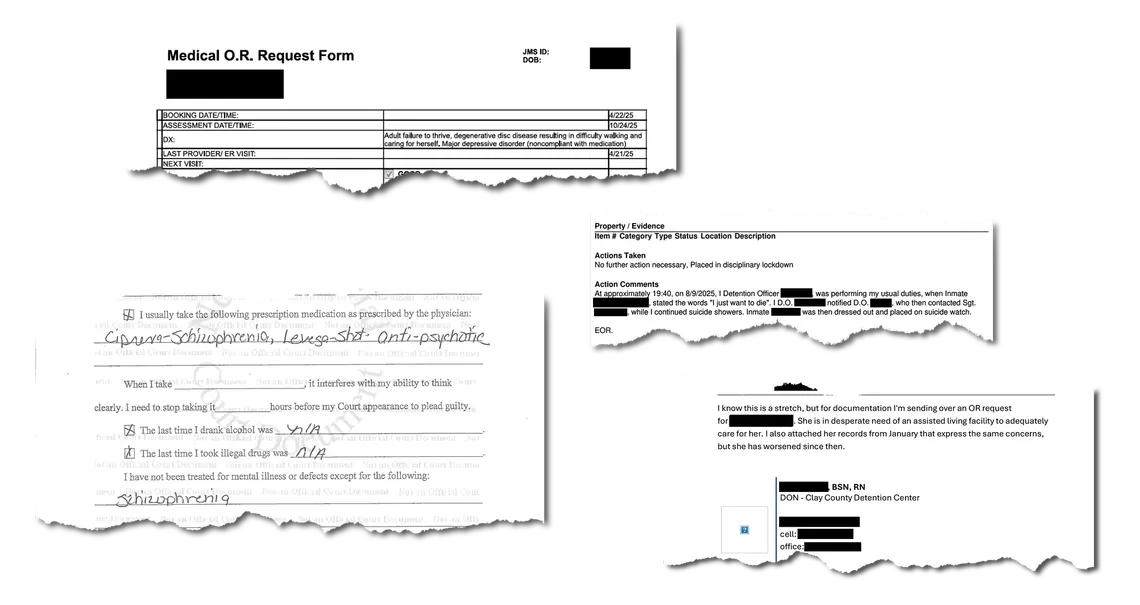
A jail nurse wrote in an email, “She is in desperate need of an assisted living facility to adequately care for her.” In response, a state mental health chief of forensic operations wrote that the defendant remained on the admission list, “but if a different placement is identified and secured for her that will be wonderful.”
Sometimes, jail staff need to use creativity and patience to help defendants. That could mean repeating an answer to the same question all morning as they try to build trust, hoping the person won’t be scared to leave their cell when they get time to take a shower, for instance.
One defendant needed to be bribed with orange slices. The 27-year-old, who identifies as male and was held in the women’s area of the jail, was combative, refused to wear any clothing and rarely left the cell.
The situation underscored the complex cases facing jail staff. The defendant had experienced childhood trauma, served overseas in the U.S. Army Reserve, became homeless, landed in jail after allegedly scratching a police officer during a traffic stop, seemed to have conversations with people who weren’t there and changed names to include “God” in his surname.
“I am sure he’s feeling like a caged animal,” said a family member, who had only recently learned of their loved one’s detention. “I am not sure he grasps that he really needs some help. In his mind, whether he’s calling himself God or God’s helper, he’s doing what he needs to do and everybody else doesn’t understand.”
Hard time
After five months in the county jail in 2021, Louis’ public defender requested a mental health examination. The results couldn’t come soon enough, considering the chaos as shown in incident reports and video footage.
A group of detention officers decked out in riot gear had already forcefully extracted him from his cell. They locked him down in solitary as he awaited a hearing for allegedly causing disturbance, tampering with the toilet, threatening staff and failing to obey directives.
They were back inside in early 2022, to apply more force. They reported that his cell was dark and flooded, with the windows and camera covered. Louis paced, screaming at the officers. After he refused to lie down with his hands behind his back, the officers deployed a chemical agent through the food slot in the door, according to the incident report.
When Louis finally lay down, they rushed in and pressed a shield on him. They cuffed his hands and feet, then put him in a restraint chair “for his own safety, to prevent damage to county property, and to prevent harm to staff,” the report said. Louis tried to stand up, straighten his arms and ball his fists to avoid being strapped down.
Parked in a solitary confinement cell, this time he sat in the restraint chair for 4 hours and 20 minutes “due to threats he was making to staff” checking on him, the report said.
Four months later, in April 2022, it was more of the same, only the tactical team fired pepper balls.
In August 2022, the state’s mental health evaluation determined that Louis was indeed competent to stand trial, though court records say he didn’t participate in the evaluation. His public defender asked for another evaluation, which would take another 10 months.
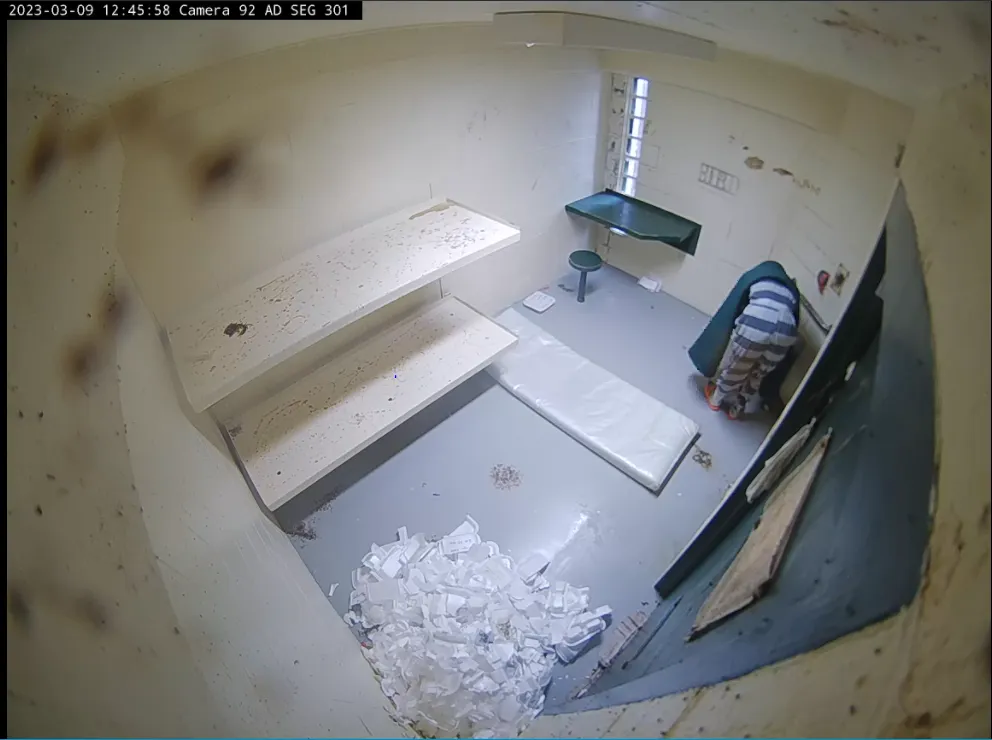
During that time, Louis continued to decline. Instead of coming to court, he sat in his cell, covered in feces and urine. He would store feces in old Styrofoam food containers and lay them out on the floor by the door like landmines.
In one of the rare times Louis agreed to shower and have his cell cleaned, an officer asked why Louis was using fecal matter to write on the walls. Louis said he “got tired of looking at the same wall and wanted to make it look different and his own.” He told the officer that he used feces to mask the smell of others in jail.
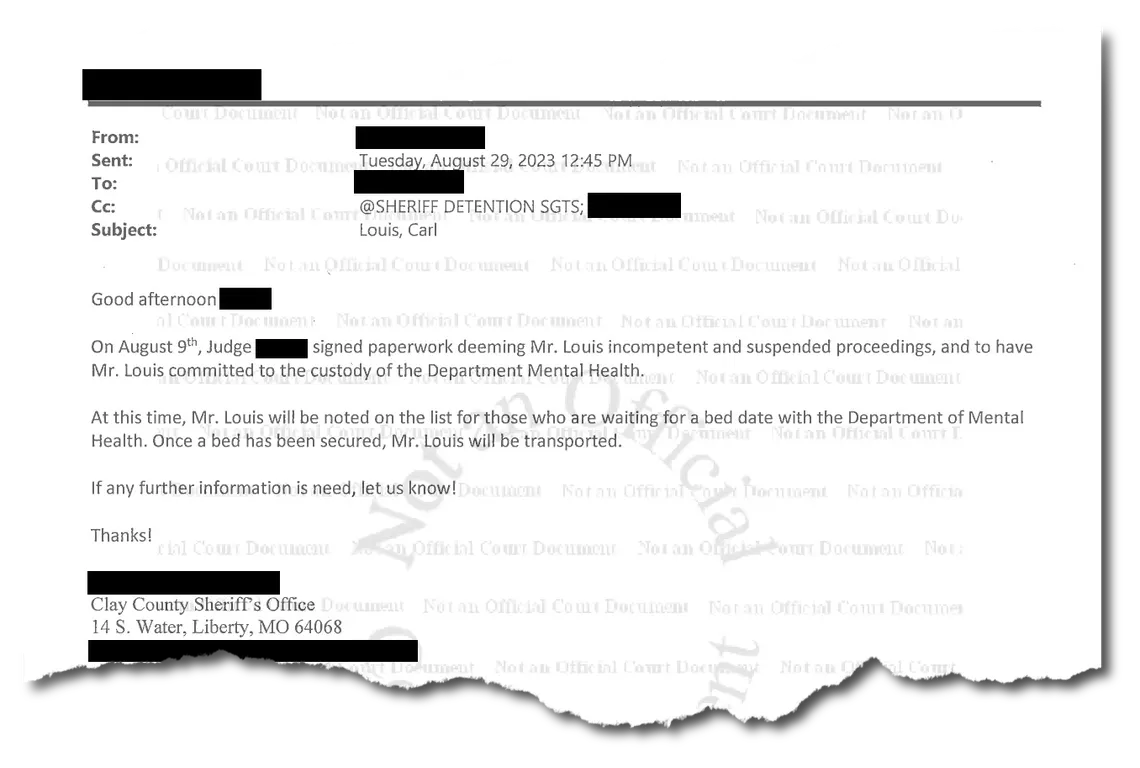
After his second mental exam found Louis to be incompetent to stand trial, the Department of Mental Health sent him back to Clay County to wait for a treatment bed, despite reports that he exhibited alarming behaviors.
The jail escalated force.
“Please let us know when you feel it’s time we start tightening down the reins on Mr. Louis based on his mental behavior according to your training and expertise please?” Clay County Sheriff’s Capt. Paul Norris wrote in June 2023 to another jail leader upon Louis’ return.
Five days later, during a confrontation, Louis was dragged out of his cell with Taser probes stuck in the center of his back, according to an incident report. More threats and intense cell extractions continued.
In August 2023, a judge suspended Louis’ criminal cases and ordered him committed for treatment. Again, without an open bed, the jail had to keep him. Potentially adding more jail time, an officer pursued a criminal charge against Louis, accusing him of hitting her in the face, mouth, neck and torso with human waste.
Another officer said he was “worse than ever before.”
Lt. Tracy Wade, who oversees jail operations, said they called the state numerous times about Louis.
“I had somebody that I needed to get help for and the resources weren't there,” Wade said. “I'm sure they were frustrated, but I was frustrated with the response, which was there's nothing we can do.”
The state finally agreed to take Louis in January 2024, two and a half years after his arrest.
Pilot error
Akin, the sheriff, saw an opportunity in the state’s $2.5 million pilot program that would provide competency restoration inside five of the state’s biggest jails. Akin said he wanted the sickest defendants in his jail to get help, rather than languish as Louis did.
“No one should ever live like that. I don't care what you've done. There's laws against living like that,” said Akin, whose own history of being unhoused as a child growing up in California informs his approach to law enforcement.
Akin and local judges were already concerned about possible constitutional violations for indefinitely holding defendants, often in isolation. “I just don't feel good locking anyone down for 23 hours a day. Isolation should be a very temporary solution until we can find out a long-term solution. Isolation does more harm to someone than the good,” Akin said.
It took months of planning and hundreds of emails to get the partnership with the state off the ground in September 2024. The jail was paid $900 a day to participate. In return, Clay County needed to guarantee a separate space for 10 people in the restoration program — including defendants sent from other jails in northwest Missouri. Since the Clay County jail was usually full, general-population jail residents were sent elsewhere to make room.
Akin said it took a long time for the state to hire people to run the program for low pay. Once they did, he said, defendants had to be medically compliant to participate. The severe cases — those who were disruptive, violent and not grooming themselves — were left for jail staff to deal with like before.
“They were too much for the staff that they could pay and hire to be here,” Akin said, adding that a state forensic mobile unit — part of another new $1.7 million initiative approved by lawmakers — didn’t provide sufficient support.
In May 2025, the jail compiled a list of concerns about the pilot program and shared them with the state.
“Several inmates with serious mental health issues remain in custody without the care they urgently need, even though we’ve documented their conditions,” jail leaders wrote, including as examples a “severely decompensated” defendant “exhibiting constant screaming,” another who threatened staff and a third who frequently engaged in public sexual misconduct.
“I don’t understand how we got here from the original meeting in the courthouse,” Akin wrote to Jeanette Simmons, deputy director of the state agency. “I want to help those in need, but I feel like we’re sacrificing in ways we simply cannot anymore.”
Clay County left the pilot-program contract in January 2026. A jail in southwest Missouri never reached an agreement. The Department of Mental Health said there are about 30 people in the remaining three jail-based programs in Kansas City and St. Louis.
Thinking clearly, moving on
Once the state finally accepted Louis for in-patient treatment, it took about eight months to restore his competency. The jail was apprehensive about taking him back in fall 2024, but his behavior was much different. Detention officers didn’t need to wrestle him out of his cell and into the restraint chair again; Louis participated in his own legal defense in court.
In late 2025, more than four years after his arrest, he signed a guilty-plea deal with prosecutors on a lesser charge. The detention officer who sought charges against Louis dropped the case after he was accepted to treatment and blood tests came back not showing exposure to any disease.
After a short prison stint, Louis said he was dropped off in March at a bus station with $5 and orders to show up at the Transition Center of St. Louis, a state step-down facility for people released on parole without a home plan.
During a two-hour conversation at the center, he said he felt cheated by the stiff charges from the smokeshop encounter and that he had had to figure out the complex legal consequences on his own. He described a power struggle between him and detention officers, and explained the primitive methods he used to fight back.
“When I couldn’t get my way, because I was getting Maced up all the time and restrained, I just, you know, put nasty stuff on the wall,” he said.
He added, “I really got scared.”
At the state hospital, he said, he attended classes and was part of a treatment program. He started taking medication. If he didn’t comply, the director of the transition center would be alerted. Louis said, though, that medication wasn’t part of his long-term plans.
“I’m thinking clearly,” he said. “I don’t want to keep taking it over and over.”
At the end of July, The Marshall Project caught up with Louis. He said he’d graduated from all of his classes at the center and earned the freedom to venture beyond the security fence, out past the nearby encampments of unhoused people along the Mississippi River front.
He yearned to head back to more familiar streets in New York. But first he needed to meet the conditions of his parole and show continued stability by looking for a job.
At heart, he’s still a traveler. He strolled the Gateway Arch grounds and museum, dressed much like the others from out of town with time to kill. He wore gray shorts and sneakers. A handmade red rosary necklace lay draped across the front of a black T-shirt. He’s put on weight since his time at the Clay County jail, with a little gray in his beard.
“Everywhere has been nice but Missouri,” he said of his journey.