For the past two years, The Marshall Project has reported on faulty drug testing of patients during childbirth that can lead child welfare agencies to separate newborns from their parents. Our new data collection effort exposes how often these agencies across the country take another step: notifying law enforcement of the alleged substance use.
We spent a year compiling and verifying data on law enforcement referrals. Our analysis shows that over a six-year period, child welfare agencies in 21 states referred parents to police or prosecutors more than 70,000 times over alleged substance use during pregnancy. The greatest frequency occurred in Oklahoma, where 1 in 24 births resulted in a referral to law enforcement.
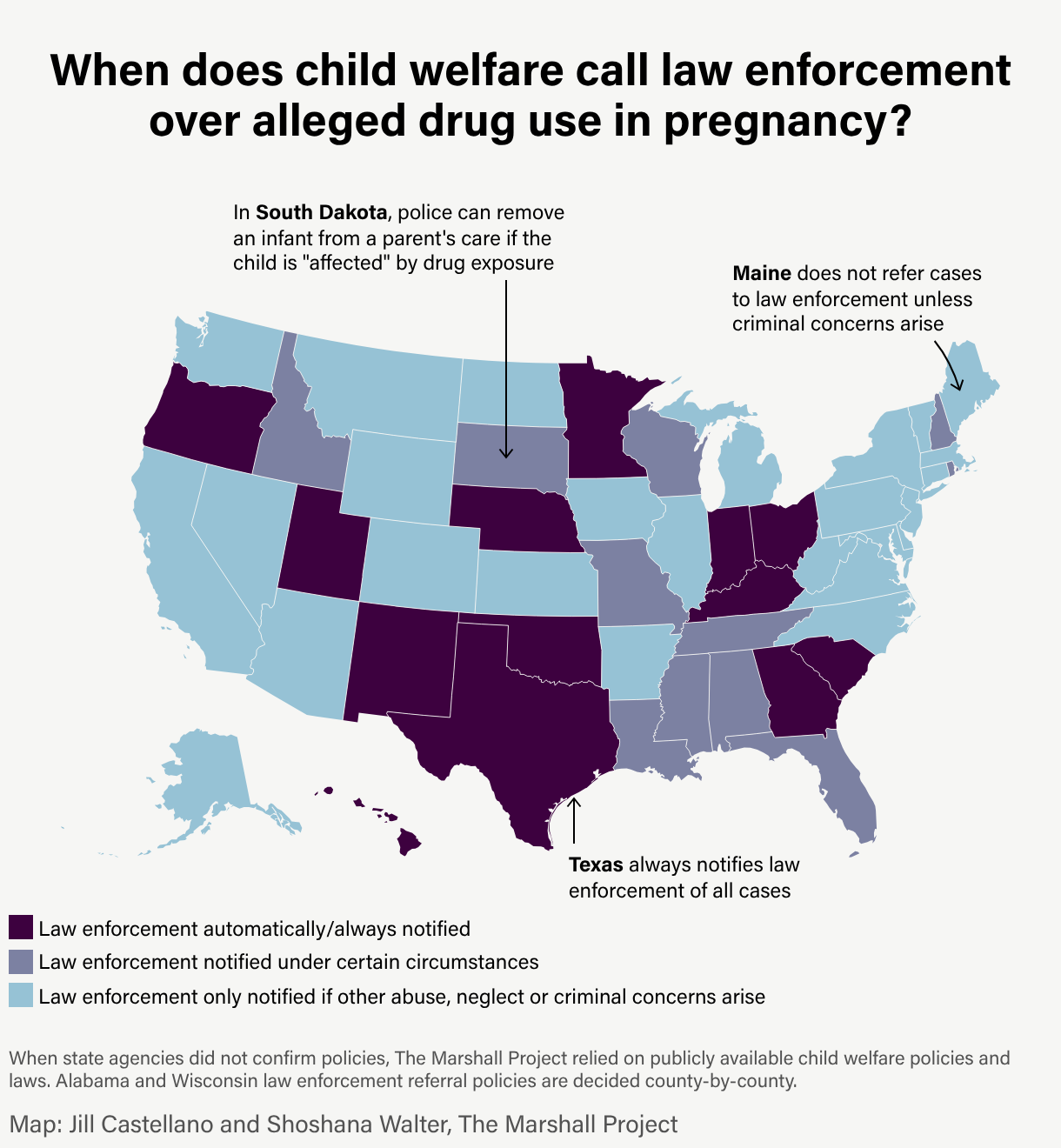
The referral process typically starts when a patient or newborn tests positive for drugs while in a hospital. In most states, hospitals are required to notify child welfare authorities, even though the drug tests — often urine screenings — are known to be highly unreliable. State laws and policies dictate whether child welfare must then share those reports with law enforcement. We found that 13 states require all those allegations to be shared with police or prosecutors, regardless of the outcomes of any child welfare investigations.
If you’re a journalist or researcher interested in investigating the issue, check out our toolkit to learn how to report on false-positive drug tests and allegations of substance use during pregnancy.
How we got the data
State child welfare agencies can voluntarily submit data about newborns exposed to substances in the womb to the federal Children’s Bureau, which is part of the U.S. Department of Health & Human Services. The records are collected and analyzed by the National Data Archive on Child Abuse and Neglect (NDACAN). While some figures are published in government reports, data on referrals to law enforcement was not publicly available prior to our reporting.
The Marshall Project made several requests to NDACAN between December 2023 and March 2025 seeking the annual number of newborns reported to child welfare in each state, as well as the number of these cases referred to police or prosecutors. We originally received anonymized data for 20 states covering federal fiscal years 2018 through 2023.
Checking the data with each state
We contacted the 20 states with NDACAN referral data to check the accuracy of their submissions. Eight state child welfare agencies verified the data was appropriate to use for our analysis.
Officials in Georgia, Hawaii, Idaho, Illinois, Minnesota, Texas and , Utah said their numbers were outdated or incomplete and gave us updated data. Arkansas and New Jersey officials said their numbers were inaccurate, so we removed them from our analysis.
Officials in California would not confirm the accuracy of their submissions. In New Hampshire and Mississippi, they did not respond to emails and phone calls seeking confirmation. The data these states sent to the Children’s Bureau was included in our analysis.
We added three more states — Kentucky, Oklahoma and South Carolina — after confirming data with state officials. Though these states did not send referral data to the Children’s Bureau, they did submit data on the number of pregnancy substance use allegations that child welfare agencies accepted for review. In each state, we verified that the agencies refer all of these cases to law enforcement and incorporated the totals into our analysis.
When possible, we defaulted to the information states gave us if there was a discrepancy between the state and federal data, since the federal data was submitted by the state agencies we were in touch with. In Georgia, Utah and Minnesota, state officials only provided data for certain years or variables, so we supplemented with additional data points from NDACAN.
After those confirmation efforts, we were left with full or partial data on referrals in 21 states.

What’s in the data
The data we compiled included the following fields:
- Year: Federal fiscal years 2018 - 2023. Each year covers Oct. 1 to Sep. 30. Some states only had data for part of the six-year period.
- State: After verifying data with state agencies, we ended up with 21 states in our referrals analysis.
- Total Pregnancy Substance Use Cases: The totals are counts of newborns who were reported by medical providers to child welfare authorities over concerns they were exposed to substances in the womb. In some states, this contact constitutes a report of child abuse or neglect, triggering a child welfare investigation, while in others, it’s considered a notification — not a child abuse report — and triggers an assessment that is focused on supporting the family’s needs rather than determining whether a child was maltreated. The data doesn’t differentiate between allegations resulting from positive drug tests, admissions of drug use and other reasons.
- Victims Referred to Law Enforcement: The totals represent “victims” of alleged substance use during pregnancy whose cases were referred by child welfare authorities to law enforcement. Child welfare agencies can classify a child as a victim if they deem abuse or neglect is suspected or substantiated. In some states, illicit drug use during pregnancy is enough for a finding of child abuse or neglect, while in others, an infant must show signs of being “affected by” the substances, such as withdrawal symptoms.
- Nonvictims Referred to Law Enforcement: The totals represent “nonvictims” of alleged substance use during pregnancy whose cases were referred by child welfare authorities to law enforcement. Child welfare agencies can deem a child a nonvictim if they find that claims of abuse or neglect are unsubstantiated or if they redirect the case to “alternative response,” which connects families with support services rather than triggering a formal child welfare investigation. Some states require all allegations of child maltreatment to be forwarded to law enforcement, even if they find no evidence of abuse or don’t open a formal investigation. Referrals can take place before or after child welfare investigations are complete, depending on state policies.
How we analyzed the data
The Children’s Bureau categorizes all reports as involving children who are either victims or nonvictims of abuse or neglect. We added together the numbers of victim and nonvictim cases referred to law enforcement to get the total number of referrals.
We used case totals and referral totals to calculate the percentage of cases that child welfare agencies referred to law enforcement in each state. When victim and nonvictim counts were available, we divided the number of nonvictims referred by the sum of victims and nonvictims referred to determine how often cases were forwarded to law enforcement when child welfare agencies did not find that abuse or neglect occurred.
Using birth figures from the Centers for Disease Control and Prevention’s CDC WONDER database, we calculated ratios showing the frequency of referrals compared with the number of live births in each state. The analysis aggregated monthly live-birth data to federal fiscal years and only included years when a state’s referral data was available.
We estimated the number of cases that were not referred to law enforcement by subtracting total referrals from total pregnancy substance use cases.
Findings
The data, covering a six-year period from Oct. 1, 2017, through Sep. 30, 2023, reveals that child welfare agencies in 21 states referred at least 70,778 reports of alleged substance use during pregnancy to police or prosecutors.
The Marshall Project’s count is unprecedented. Pregnancy Justice, a reproductive rights group that has been tracking arrests and prosecutions nationwide, counted more than 1,800 cases of pregnancy-related criminalization between 2006 and 2024. The number of referrals identified by The Marshall Project far exceeds any count previously identified by academics or advocacy groups.
Georgia, Oklahoma and Minnesota referred the most cases to law enforcement, with Georgia alone referring nearly 18,000 cases over six years.
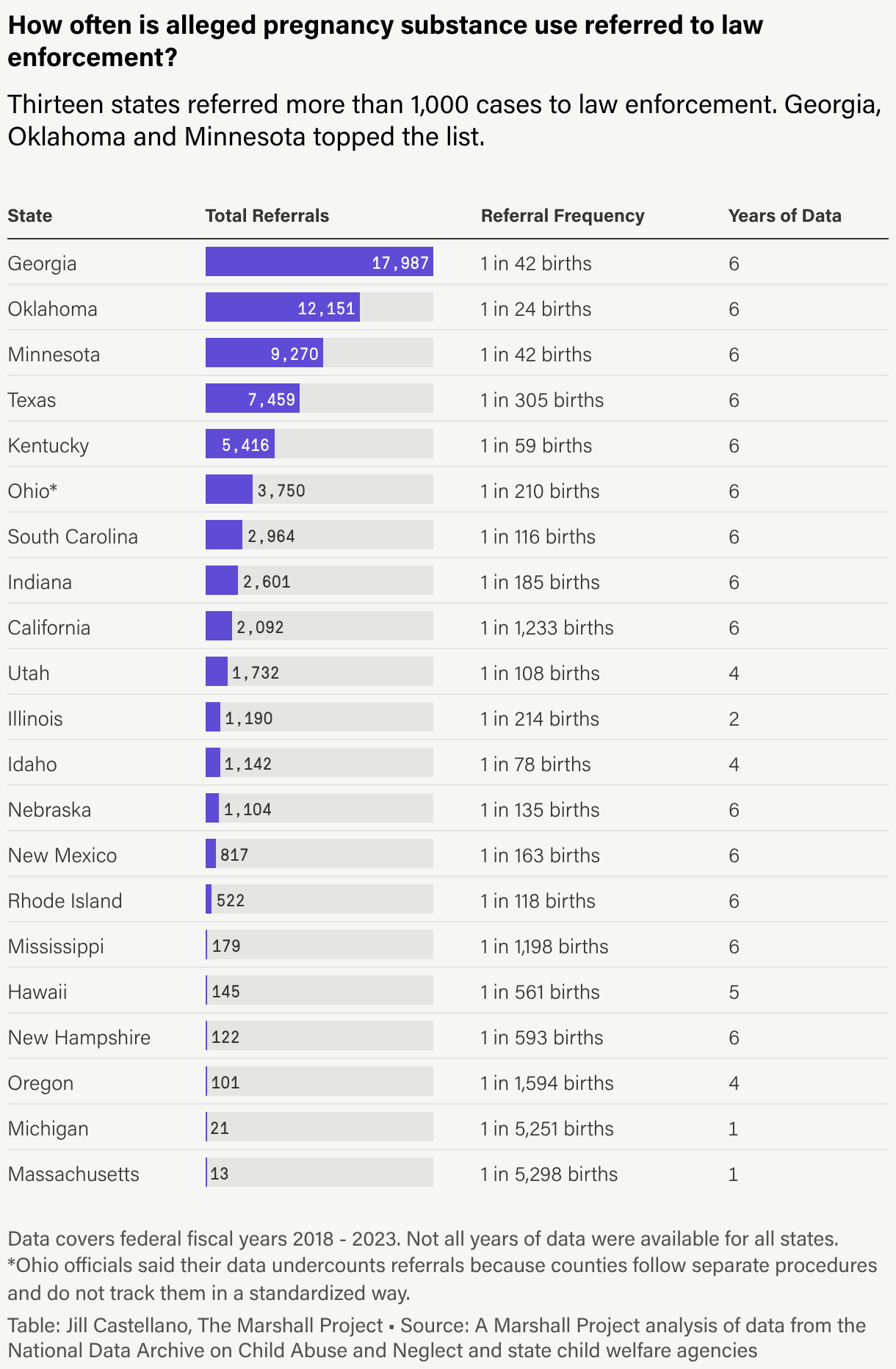
In 13 states, child welfare agencies have a policy of always referring cases of pregnancy substance use to law enforcement. Many of these policies seek to comply with state laws and can result in referrals to law enforcement before child welfare agencies have reviewed the facts of the case.
The Marshall Project verified data from 15 states about the outcomes of child welfare investigations. In about 55% of cases referred to law enforcement, or around 22,000 instances, child welfare agencies did not find that child abuse or neglect occurred. Even so, police received copies of the reports, in some cases triggering criminal probes that continued well after child welfare authorities declined to take further action.
You can explore the data for all states using our interactive tool.
Understanding the limitations of the data
In exchange for federal funding, state child welfare agencies may voluntarily submit data to the Children's Bureau on newborns exposed to substances in the womb. Under the Comprehensive Addiction and Recovery Act, states first began submitting this data in 2018.
The data tracks the number of newborns potentially exposed to substances rather than the number of parents who are accused of substance use. A parent could appear in the data more than once if they had multiple infants during one pregnancy or multiple pregnancies that triggered reports to child welfare.
Not all states have a comprehensive system for tracking referrals, which could lead them to underreport totals to the federal government.
For example, officials from Ohio’s Department of Children and Youth said counties follow separate procedures for referrals and do not track them in a standardized way. State officials confirmed their policy is to refer all child abuse and neglect reports received by the agency if law enforcement has not already been made aware of the report in some other manner. While this policy suggests a high referral rate, state data only captures referrals in 12% of cases.
The data we obtained for this analysis does not cover several important elements of the process for referring patients to law enforcement. It doesn’t provide specific details on individual cases, nor does it distinguish between cases where referrals went to police or to prosecutors. It does not specify whether a child welfare investigation substantiated abuse or if abuse was just suspected. The data does not capture why a child welfare agency decided to refer the case – to prompt a law enforcement investigation, to request an officer’s presence if a caseworker feels unsafe or for other reasons. It also does not detail what law enforcement did following the referral, such as opening a criminal investigation, arresting or prosecuting a parent or taking no action. Child welfare authorities may include other claims beyond substance use in their referrals, such as child abandonment or sexual abuse — but data on these additional allegations is not available. Questions relating to any of these elements are beyond the scope of our analysis.
States that don’t appear in our analysis could have submitted a small amount of data to the federal government that was not provided to us for confidentiality reasons. NDACAN did not provide us with state victim or nonvictim case counts if the totals were smaller than 10 per year, to protect individuals’ privacy. For years when data was provided to us, a state’s referral totals could undercount up to nine cases per year if either victim or nonvictim data was not provided. As a result, our calculations undercount referrals by the same amounts.
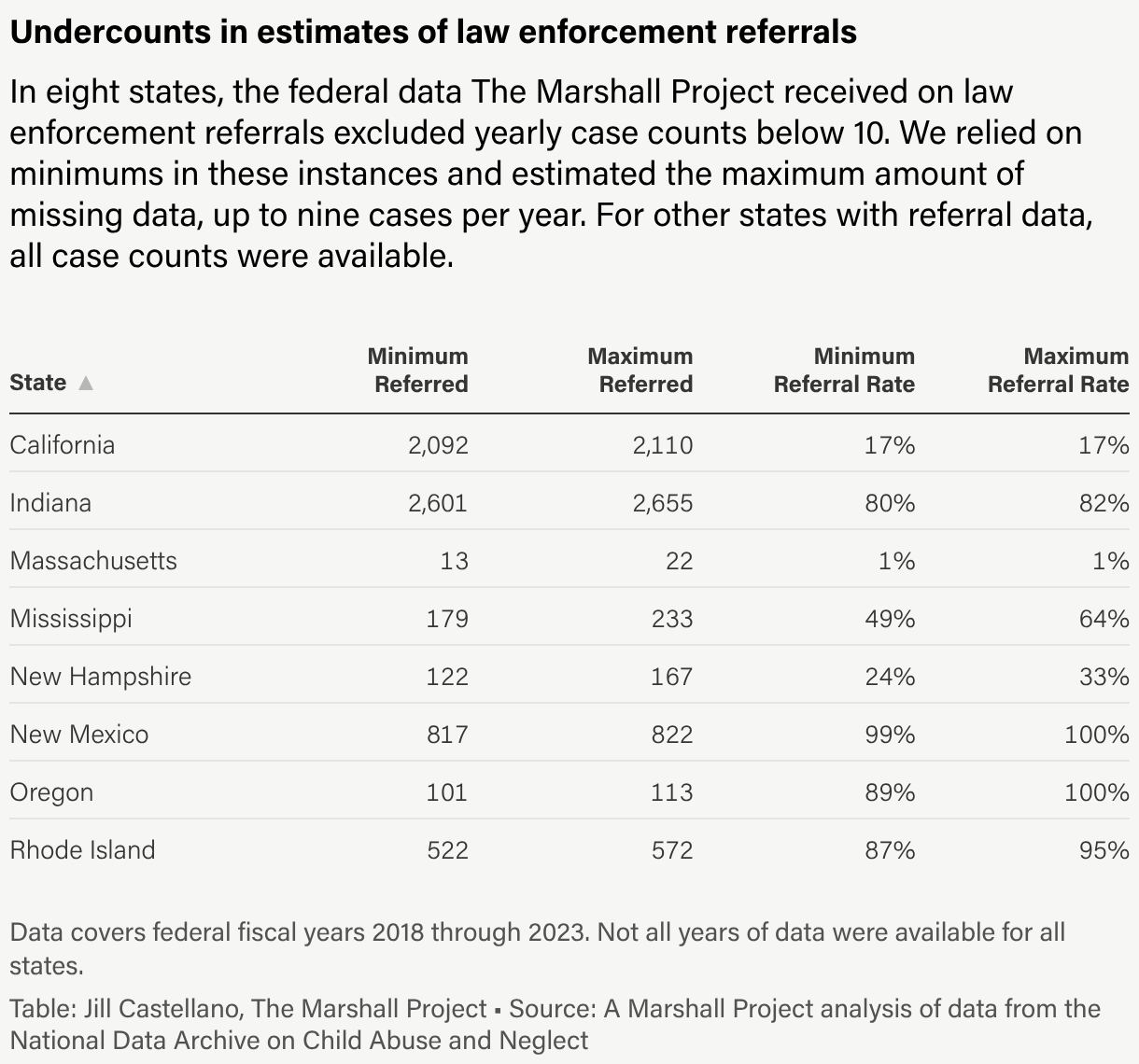
In California, Mississippi and New Hampshire, where officials did not confirm the reliability of their data, the referral data they reported to the federal government could be inaccurate.
With data limited to 21 states, a comprehensive, nationwide analysis is not possible. Updates to federal law or policy could mandate reporting of these figures to offer a more complete picture.
Collecting state child welfare policies
Each state child welfare agency follows a set of laws, policies and practices for screening, assessing and referring allegations of drug use during pregnancy. The Marshall Project reached out to those agencies in all 50 states and Washington, D.C., to understand the policies and laws for referring these cases to police or prosecutors. This yearlong process involved back-and-forth communications with officials to understand the nuances of their work.
Officials in 47 states and Washington, D.C., answered our questions and fact-checking requests. Three states did not respond: Louisiana, Mississippi and New Hampshire. For these states, we relied on laws and policy documents obtained through public record requests.
Using all available materials, we classified state policies into three categories:
- Law enforcement automatically/always notified: Child welfare agencies in these states share information with police or prosecutors about all accepted reports of alleged drug use during pregnancy.
- Law enforcement notified under certain circumstances: An allegation of drug use during pregnancy could prompt a referral in some situations, but not all. For example, referrals may occur only for certain types of illicit substances, or policies may vary by county.
- Law enforcement only notified if other abuse, neglect or criminal concerns arise: These states do not contact law enforcement if the only concern is drug use during pregnancy. However, the case could be referred if there are other allegations of abuse or evidence of a crime.
We wrote short summaries of states’ policies and gave each state an opportunity to review for accuracy prior to publication. We adjusted our summaries as necessary based on their feedback.
Accessing the data
The Marshall Project is making state data and policies on law enforcement referrals available to the public for the first time. You can review the data dictionary here.
State referral policies: For 50 states and Washington, D.C., we provide our written and fact-checked summaries outlining when child welfare agencies refer cases of alleged drug use during pregnancy to police or prosecutors. The file also includes which of the three policy categories we classified each state’s policy into. You can download a CSV file with this information here.
Statistics on state referrals to law enforcement: For each of the 21 states with referral data, we provide state-level statistics on the total number of referrals that child welfare agencies make to law enforcement, the percent of pregnancy substance use cases that the agencies refer to law enforcement and number of years of data available. The file also incudes our calculation of referral frequency based on the number of live births in each state. You can download it by clicking this link.
Annual data on law enforcement referrals and pregnancy substance use cases per state: The file includes annual breakdowns for the number of allegations of drug use during pregnancy per state that were accepted by child welfare agencies, as well as the number of those allegations that were referred to police or prosecutors. For some states, the data includes how many referred cases involved children deemed victims or nonvictims of child abuse or neglect. We are only publishing fields and years of data that are reliable enough for analysis and that maintain individuals’ privacy. Full or partial data is available for 44 states and Washington, D.C. You can download it here.
If you are a journalist or researcher interested in investigating the consequences of hospital drug testing at childbirth, we’ve designed a reporting toolkit with free data visualizations, a FOIA template, advice on finding impacted sources, and an interactive tool so people can look up the policies and data in their states. We’re also working on identifying sources for these stories. If you’re interested in learning more about this effort, please email investigatethis@themarshallproject.org.
ACKNOWLEDGEMENTS
Thanks to current and former staff of NDACAN for help with processing our special data requests, including Randi DeLong, Alexandra Gibbons and Michael Deneen. Thanks to staff at NDACAN and the Administration for Children and Families for explaining the federal data collection and publishing process in detail. Thanks to Michael Lavine (University of Massachusetts Amherst) for reviewing our analysis of state birth rates. And thanks to the dozens of state spokespeople and data analysts at child welfare agencies who responded to our many questions.