Ayanna Harris-Rashid was sitting up in bed, her newborn son latched to her breast, one hand scrolling on her phone, when the police called. She was wanted on a felony charge of child neglect.
Harris-Rashid had just had her third child in March of 2021. To ease pain and frequent nausea, she had used legal CBD gummies and a topical hemp-based ointment throughout her pregnancy. But at the hospital, she and the baby tested positive for marijuana, prompting providers to file a report with the South Carolina Department of Social Services, which forwarded the information to police, records show. Now an officer was demanding Harris-Rashid turn herself in.
Harris-Rashid said goodbye to her children and husband. “I’m so sorry,” she whispered to her newborn son. A friend drove her to the sheriff’s office, where she was handcuffed, strip-searched and placed for the night in a cold and crowded cell. By the time she left the jail the following morning, her milk supply had decreased and she found she could no longer breastfeed. The charge was eventually dropped.
“They shook me bare. They made me feel very indecent and inhumane,” she said, adding, “This is a person, a woman, a mother, an actual individual. What justifies this?”
What happened to Harris-Rashid is happening to women across the country with staggering frequency. In at least 70,000 cases in 21 states, parents were referred to law enforcement agencies over allegations of substance use during pregnancy, according to six years of state and federal data obtained and published for the first time by The Marshall Project. In many cases, the referrals began with false positive results from flawed drug tests — sometimes triggered by the women’s prescribed medications.
The sheer number of people that law enforcement is tracking is far higher than experts previously knew, including academics and reproductive rights organizations monitoring what they call pregnancy criminalization. Even so, the numbers The Marshall Project compiled represent a significant undercount.
“My initial genuine reaction is, frankly, shock and dismay,” said Dana Sussman, senior vice president of the legal advocacy organization Pregnancy Justice, which counted more than 1,800 pregnancy-related arrests and prosecutions from 2006 through 2024. She added, “This represents an incredibly regressive and counterproductive approach.”
 to tell us if you’ve had a brush with law enforcement during your pregnancy, labor or delivery.](https://mirrorball.themarshallproject.org/_ZtrqW1D2uPbA9_tvdmG8kIgbOilpmErYXmPsrlctow/w:1140/aHR0cHM6Ly9kMm0x/OXBtdnRzNWJvYi5j/bG91ZGZyb250Lm5l/dC8zaTEzMjFsMHB0/ZTd5bTV5bDVzZnBs/M3F6czlmL1NjcmVl/bnNob3QlMjAyMDI2/LTAyLTEwJTIwYXQl/MjA5LjI5LjU2JUUy/JTgwJUFGUE0ucG5n.webp)
The Marshall Project spent a year collecting and analyzing data on referrals to law enforcement. Reporters began with a request for federal data, then asked state child welfare agencies to verify the numbers and provide state policies. The totals reflect the number of newborn cases that those agencies shared with police or prosecutors.
Although most of those referrals did not lead to criminal investigations, many women were threatened with arrest or criminally charged. Others were confronted by police in their hospital rooms or homes and forced to turn over their children.
Read an in-depth methodology showing how The Marshall Project obtained the data and conducted its analysis.
In Oklahoma, armed sheriff’s deputies took two children from their parents after the mother tested positive for meth, a false result triggered by the acid reflux medication the hospital had given her during labor, according to court records and her lawyer. In South Carolina, police interrogated a mother after she tested positive for the fentanyl from her epidural, as well as marijuana, according to police records.
And after a Virginia couple insisted on having an attorney present for a child welfare interview, a police officer threatened them with arrest if they didn’t surrender their newborn. “When we step in, that’s when we start charging people,” the officer told the parents, according to an audio recording of the meeting. “You got about three seconds.” The mother had tested positive for methadone, the medication prescribed to treat her opioid addiction. The parents were forced to leave their newborn in the hospital and police escorted them out, records show.
The Marshall Project and other news organizations have previously reported on prosecutions of people accused of using drugs during pregnancy. But this new investigation shows a much broader swath of patients being surveilled by hospitals, child welfare authorities and law enforcement than previously known — even while the underlying evidence for those allegations is unreliable, easy to misinterpret and sometimes flat-out wrong.
Many of the women who tested positive likely used illicit drugs. But data from three states that specifically track cases involving prescriptions show that thousands of new mothers were referred to law enforcement based solely on medications their doctors gave them.
In many states, referrals to police occurred even though some child welfare agencies ended up dismissing the allegations, or never accepted the reports in the first place.
The Marshall Project received data from 15 states about the outcomes of child welfare investigations. More than half of the cases referred to law enforcement in those states — about 22,000 — were found not to involve child abuse or neglect. Yet police sometimes launched criminal probes that continued well after child welfare authorities declined to take further action.
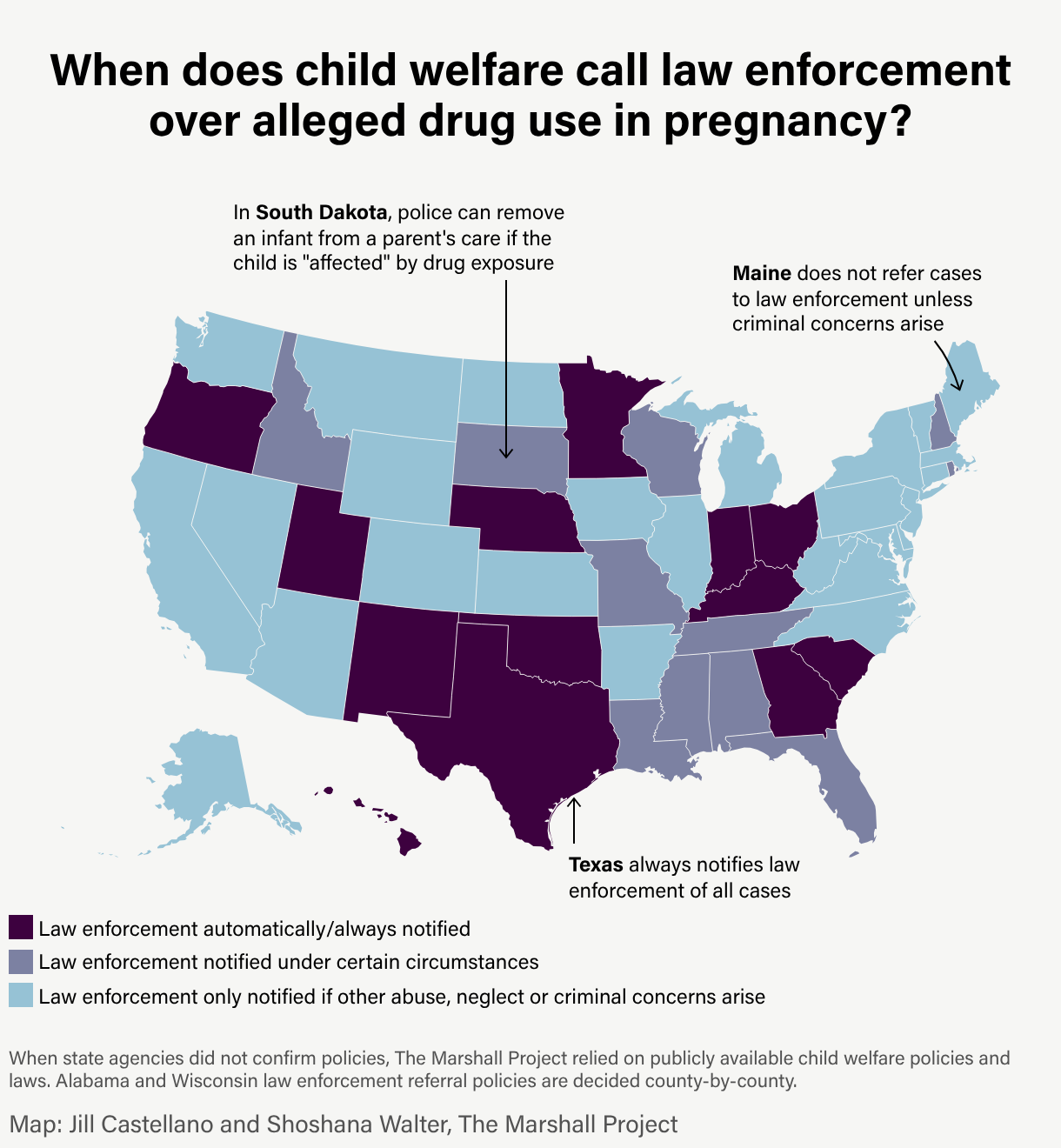
Some states are making very few referrals to law enforcement. In Michigan, child welfare officials send cases to police only in very specific circumstances — for example, if there are concerns for a caseworker’s safety or allegations of serious physical harm to a child. Fewer than 1% of reports in the state were shared with law enforcement, The Marshall Project’s analysis found.
But in 13 states, child welfare agencies automatically share all such reports, according to a Marshall Project review of policies in 50 states. They span blue states like Minnesota to red states like Oklahoma, where a case is referred to law enforcement in one out of 24 births, a higher ratio than in any other state in the analysis.
Federal law requires states to refer families to services and ensure that they have plans to care for newborns exposed to substances. States that automatically send every report to police are far exceeding federal requirements, experts said.
“[The law] does not call for any criminal justice response,” said Nancy Young, the executive director of Children and Family Futures, a nonprofit that helps child welfare agencies implement federal requirements. “It doesn’t help in the long run. And it doesn’t help the baby.”
Decades of research suggest that using certain substances during pregnancy may harm the baby. Some illegal drugs are associated with early birth or stillbirth and can cause babies to experience withdrawal symptoms. Chronic use of cigarettes and alcohol can cause low birth weight and developmental delays. But studies show that punishments are ineffective at reducing substance use and can lead to poorer health outcomes for women, newborns, and families. Recognizing the potential for lasting harm, Illinois legislators in 2024 ended the requirement that child welfare authorities notify law enforcement.
Some states have set up alternative responses to offer services to families and steer them away from child abuse investigations. Yet several of these states also file automatic referrals with police, undermining what experts view as years of progress.
“I’m flabbergasted,” said Deborah Cohen, a professor at Oregon Health & Science University who studies the treatment of pregnant women with substance use disorders. Cohen said she had no idea state authorities forwarded reports of such patients to law enforcement. “I do not see how that’s helpful.”
In Alabama, the state’s child welfare agency accepted at least 3,403 reports of alleged substance use during pregnancy over six years. It’s unclear how many were referred to law enforcement because the federal program that collects the data did not provide it to The Marshall Project. States are not required to report this information.
Child welfare officials said counties have their own agreements with local police and district attorney’s offices about what child abuse and neglect reports are shared with law enforcement. Referral practices vary across the state.
The referrals are not always made for the purpose of filing criminal charges. In some states, they are a matter of administrative routine, required for any child abuse and neglect report. Child welfare authorities also call police to assist with emergency foster care removals, or to go with a worker on a home or hospital visit. In many states with automatic referral policies, police or prosecutors review the reports and file them away.
But criminal prosecutions of pregnant women have been rising for years, with a significant jump following the Supreme Court’s Dobbs decision in 2022, which overturned Roe v. Wade. In anti-abortion states such as South Carolina and Oklahoma, women are particularly vulnerable to prosecution, and the decision to pursue a criminal case often comes down to the discretion of a single officer or prosecutor. At a time of increasing pregnancy surveillance, civil rights attorneys and advocates for women’s rights warn that the referrals significantly increase the risk that more people will face criminal investigation and charges.
“The states that are doing these automatic referrals, that makes the women in those states incredibly vulnerable,” Sussman said. “... It opens the door — even when there’s no basis in law — to actually bring these prosecutions.”
For decades, state and federal laws have required hospitals to identify newborns affected by drugs in the womb and to alert child welfare services. In part to comply, many hospitals routinely drug test patients or babies to check if a mother might have used substances.
But the tests, which start typically with urine samples, are easy to misinterpret and often wrong. They do not show how often or for how long someone may have used drugs. Most tests cannot distinguish between a positive result caused, for instance, by marijuana — illegal in many states — or a legal substance, such as CBD products. Without confirmation testing and review, positive results often lead hospitals to accuse parents of drug use, even if the substance used was a prescribed medication.
Some law enforcement agencies may conduct additional investigations, but many do not. The Marshall Project reviewed records from two police agencies in South Carolina — one of the states most aggressively prosecuting women for pregnancy drug use — and found more than a dozen mothers were arrested solely on positive drug test results, without interviewing the accused or collecting more definitive evidence.
One of those cases was a first-time mom newly pregnant in 2024, who began to experience extreme morning sickness. She asked to be identified by her nickname, Maddie, because her court record has been expunged. Her symptoms were so severe that she could not keep even water down. The medication prescribed to many pregnant women, Zofran, did not work for her. “It was really bad,” she said, recalling her worries for her baby girl. “How is she going to be OK and grow and be fine?”
On a family member’s suggestion, Maddie tried marijuana gummies, which stopped the vomiting. But when she gave birth, she and the baby tested positive for THC.
A small amount of THC is legal under South Carolina and federal law, and many legal CBD products contain the compound. Maddie’s drug test results didn’t distinguish which product she had consumed — or how much. But the hospital reported her to the Department of Social Services. She was barred from breastfeeding, she said, and from being alone with her newborn. The following month, she was arrested on a felony charge of harming her child or placing her at risk.
“I have never in my life been in trouble. I’ve never been arrested. Nothing,” she said. Now she was facing up to 10 years in prison under state law. “That would have been more detrimental to my daughter than me doing gummies pregnant.”
Eventually, Maddie hired an attorney and the prosecutor dismissed the charge.
Some law enforcement agencies are aware of the pitfalls of drug test evidence. At the Loris Police Department, north of Myrtle Beach in South Carolina, at least half of the newborn reports involve drug tests triggered by false positives, prescribed medications or legal hemp products, said Lt. Larry Williams.
His department declined to file charges in six of 11 cases it received in 2024 due to faulty drug test results, including positives triggered by legal CBD, he said. The department has also received reports of positive tests caused by medications, such as those prescribed for ADHD, depression and pain relief during labor.
But Williams said it can be difficult to prove a false positive result. When investigators are not sure, the department often decides to make the arrest.
“We always try to err on the side of the baby,” he said, adding that positive drug tests are sufficient enough to build a case. “My level of proof is, is it more likely than not? Is there probable cause enough to believe that you did this?” Many of the women arrested may not actually struggle with addiction. Only about 10% of charged cases involve “frequent flyers” — women with serious drug problems, Williams said.
The Marshall Project data shows that South Carolina is not the only state referring reports of positive tests caused by prescribed medications.
In Georgia, there were more than 3,000 of these reports from 2018 through 2024. State child welfare workers declined to open investigations into abuse or neglect in these instances, yet referred them to law enforcement anyway.
In Idaho alone, more than 1,000 mothers were accused of child abuse and referred to law enforcement for marijuana use during pregnancy, including the illegal drug as well as topical CBD oils and creams, according to records disclosed in a lawsuit against the state. The lawsuit is challenging a requirement that these parents be placed on a state registry, barring them from certain jobs. One woman on the list told investigators that she ate a brownie from a relative’s kitchen that she later learned contained cannabis. The relative lived in Oregon, where marijuana is legal. Another woman had taken prescribed medical marijuana while living in Washington state — where it is legal — because she preferred it over the side effects from a prescription medication to curb nausea.
In Oklahoma, where medical marijuana is legal, women have been arrested and prosecuted for taking prescribed marijuana during their pregnancies.
Erin Bailey, a defense attorney in South Carolina who represented Maddie and others, said women should not be punished for taking matters into their own hands.
“Women who are experiencing the side effects of pregnancy — which are very real and very much diminished by our society — should have the ability to make informed decisions about products that might be able to help them,” she said. Policing these actions is a slippery slope, she said, since many daily activities, such as driving too fast, can also cause potential harm to a fetus. “Am I going to be subject to arrest if I’m speeding while pregnant?”
Even without criminal charges, a police officer’s presence can be traumatic and frightening for someone who has just given birth.
In Idaho, which refers all reports of illegal drug use during pregnancy to law enforcement, child welfare workers coordinate with the police to investigate. Officers can file criminal charges, such as misdemeanor injury to child, which carries a sentence of up to 10 years in prison, and can take a child into emergency custody without a judge’s order.
Surrounded by uniformed officers and a state worker who can take their newborn, many women feel they have no choice but to answer questions despite their right not to do so, attorneys and health care providers said. They added that some women were questioned while still under the influence of medications they received during childbirth. Attorney Brigette Borup, a public defender in Canyon County, Idaho, said many of her clients have no recollection of those interactions with police.
“When they get told, ‘Well, we’re going to remove your baby,’ it’s just — nothing past that point gets absorbed,” Borup said. She added, “The common story I get is, ‘I barely remember anything that happened or anything that was said.’”
Even when women have used illicit drugs, attorneys said the officers’ presence may be a violation of the patients’ due process rights. During those initial encounters, officers don’t typically offer a Miranda warning to new parents that describes the right to remain silent, or disclose the possibility that women may be arrested if they admit to drug use, according to three other attorneys who have represented women in criminal and child welfare cases in the state. Many women don’t realize that their answers could be used against them, said defense attorney Bob Eldredge, who practices in Pocatello in southeast Idaho.
“You’ve got your weapon, your uniform, you look like Batman, the mother is feeling guilty in bed, anyway — you get a confession out of her,” Eldredge said. “They treat law enforcement officers like that’s their pastor, preacher, bishop coming in, and they come clean.”
Eldredge said it’s difficult to prepare a strong defense for clients who are despondent because of the removal of their children. “You have a hard time not breaking down and weeping in front of those women,” he said, choking up. “It’s so cruel what we’re doing.”
The data The Marshall Project obtained nationwide doesn’t track what law enforcement does with the referrals and whether charges were ever filed. Many women may not be aware at all that private details of their childbirths were shared with law enforcement.
Michelle Hansford, a peer support advocate at an addiction treatment program for pregnant women in Texas, said one of her patients was reported to child welfare authorities due to a positive test caused by the fentanyl in her epidural. That disturbed Hansford enough. But she had no idea that the report also went to law enforcement.
“That would worry me,” she said, adding that if her client had a later encounter with law enforcement, officers would be able to see the report on her record. “They’re automatically going to be biased against her.”
The referrals could also have broader repercussions for pregnant people across the country.
Anti-abortion activists have said they want to bring a case to the U.S. Supreme Court to establish constitutional protections for the fetus. Criminal cases against women for drug use during pregnancy have already helped to establish case law for fetal personhood in multiple states. The referrals of positive drug tests to law enforcement agencies could help build the case for recognizing a fetus as a separate person entitled to equal protection, said University of California Davis law professor Mary Ziegler.
“The stockpiling of information like that is concerning, even if no one is acting on it in the near term,” Ziegler said in reference to the referrals to law enforcement. She said the policies do not actually help babies. “It’s literally about punishing people who are pregnant.”
The broader legality of such referrals is an open question. In 2001, the Supreme Court ruled that it was a violation of privacy for a public hospital in South Carolina to drug test pregnant patients without consent for the purposes of sharing the results with law enforcement. The ruling did not mention child welfare agencies, but some attorneys said that the decision should apply to those agencies too.
“Essentially, child welfare has become the pass-through,” Sussman said. “... The child welfare agency is acting as an agent of the police. There’s no distinction between the two.”