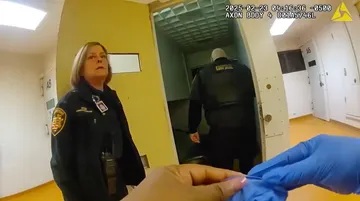
Correctional staff failed to start CPR the moment they discovered Jennifer Wade lifeless in her Cuyahoga County jail cell last year, state inspectors concluded in a review of the 41-year-old mother’s death.
It was the second such review. In the months after Wade’s death in February 2025, inspectors found that the jail staff acted appropriately. But they reopened their review after The Marshall Project - Cleveland reported on video evidence the county did not turn over to inspectors.
The officer-worn body camera videos showed that corrections staff admitted to leaving Wade alone on the concrete floor of her cell for hours before calling a nurse. A county report said employees believed she may have been pretending to be unconscious. Even after calling the nurse, more than 20 minutes elapsed before anyone began CPR.
In the state’s second review — which the county received earlier this month — inspectors concluded that correctional staff, which include MetroHealth nurses contracted by the county, had failed to start CPR immediately after determining that Wade was not breathing and that her heart had stopped.
The inspection also found that only three of the 12 county-employed corrections officers who responded were CPR trained, though the county later provided the state records showing that all 12 had completed CPR training through the American Red Cross. Still, none of the officers began chest compressions or assisted breathing.
Whether jail staff, even those trained to save lives, are required to act is unclear, with the language in the employee manual indicating officers should rely on their training but not explicitly saying they should start CPR. However, as part of their review, the inspectors required that the county submit a plan to improve its emergency response.
A copy of that plan shared Tuesday with The Marshall Project - Cleveland shows that the county intends to better train staff and conduct drills to simulate medical emergencies, each a solution the county and state have agreed to after previous deaths. Staff should also be reminded of their responsibilities and immediately activate emergency alarms.
The state has not yet approved the improvement plan.
After our initial reporting in April about the previously undisclosed video footage prompted the latest state review, county leaders created a new policy in June requiring employees of the sheriff’s office, including corrections officers, to give CPR and first aid when safe to do so, but only outside the jail.
Jenn Truxall, a spokesperson for the Bureau of Adult Detention, the state agency that oversees standards and inspects locally run jails, said basic CPR training required of all jail employees spells out that certified-staff should call for medical assistance and render aid after securing the scene.
Adam Chaloupka, general counsel for the Ohio Patrolmen's Benevolent Association, which represents the jail's corrections officers, has told The Marshall Project - Cleveland multiple times that correctional officers are trained to call for the jail’s medical workers and then wait for help.
County officials did not respond to detailed questions about the state’s new findings. Joseph Nanni, the Cuyahoga County Council’s chief of staff, said he was not aware of any council person or council staff being told about the latest failure to provide help in the jail.
Wade’s was the third death in a little more than a year in which corrections officers failed to start chest compressions despite having been certified through the American Red Cross to perform CPR, according to county records and videos.
It’s not uncommon for corrections officers to lack CPR training as state inspectors routinely cite staff for inadequate responses to medical emergencies. Jail administrators have failed to meet state requirements for CPR training in 2019, 2021, 2022, 2023 and 2025, according to state records.
Personnel and training records reviewed by The Marshall Project - Cleveland show that by February 2024, more than half of corrections officers continued to lack CPR training through the American Red Cross.
Alex Bodiford, an attorney who has filed a wrongful death lawsuit on behalf of Wade’s two children, called it "gross negligence."
Seven months before Wade’s death, a corrections officer, who had previously completed CPR training through the Red Cross, found Michael Papp motionless in a secluded cell. Instead of immediately performing CPR, the 17-year veteran corrections officer shut Papp’s cell door, walked over to a desk, sat down, picked up a phone, called a nurse and waited until she arrived. By then, Papp, like Wade, was already cold to the touch, nurses concluded.
Both corrections officers in charge of Wade’s pod held CPR certifications, but neither performed CPR before or after staff failed to find a pulse or signs of breathing.
Nor did the nurse in Wade’s cell at the time.
Officials at MetroHealth Medical Center, which the county contracts for nurses in the jail, declined to comment on the state’s finding that staff failed to render aid.
Bodiford, the attorney for Wade’s estate, said it doesn’t take an expert to spot failure when people who are CPR certified and charged with caring for people locked inside cells do nothing.
"Ray Charles could see something was wrong there," Bodiford said.
Editor’s note: After publishing this story, a county spokesperson clarified that a new policy requires sheriff’s office employees, including corrections officers, to administer CPR only outside of the jail.