For more than two decades, Vincent McFadden has been sitting on Missouri’s death row. He’s watched a steady stream of his friends get marched off to their executions — and he’s waiting for his own as he fights in court to spare his life.
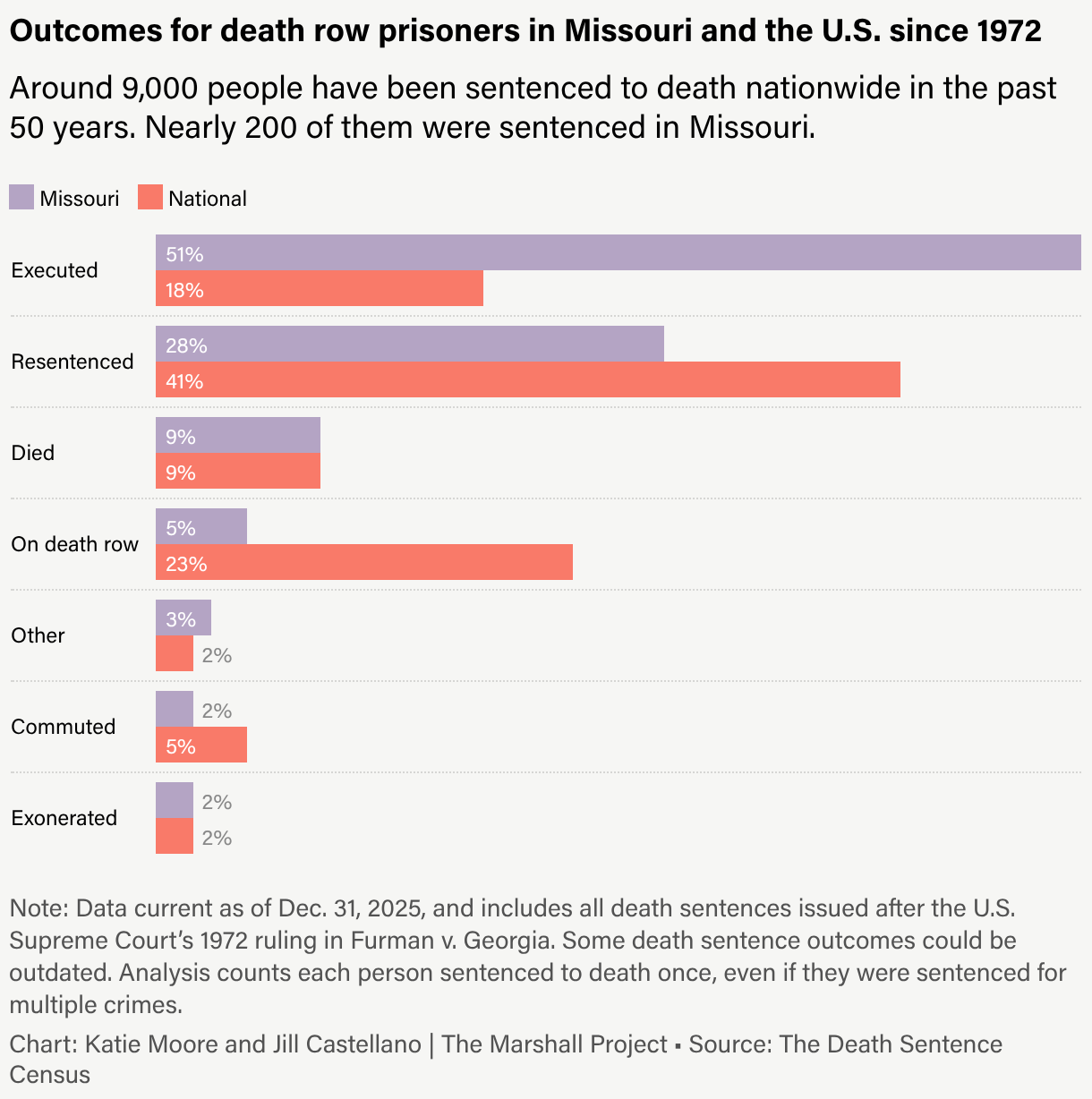
So it came as no surprise to him that Missouri is among the most prolific states to execute those facing capital punishment since the practice was reinstated in the U.S. 50 years ago. The state has executed more than half the people it has sentenced to death compared with 18% nationwide, ranking second behind Virginia, according to a Marshall Project analysis of data on state death sentences from 1972 to 2025. The data, which excluded states with fewer than 10 total death row prisoners, was compiled by Frank Baumgartner, a University of North Carolina at Chapel Hill professor, and researchers at the Death Penalty Information Center.
McFadden and critics of the death penalty see the state’s system as inherently broken with racial disparities in jury selection and in which cases prosecutors seek death. Additionally, some Missouri courts have turned a blind eye to the many factors that can impact capital cases, such as a defendant’s mental capacity.
“The state can know something is wrong but they still try to keep the conviction no matter the cost,” McFadden, 46, told The Marshall Project - St. Louis via email from death row. “Missouri has a lot that they need to grow out of and a lot they need to grow in.”
While Missouri has carried out executions at a high rate, the number of people being sentenced to death has been declining in the state since the 1990s, just as it has nationally. Prosecutors are less apt to pursue death, citing the expense of capital trials and appeals that can drag on for decades, prolonging the emotional toll on victims’ families.
Today, nine men, including McFadden, remain on Missouri’s death row, down from a peak of 96 people in the late 1990s.
Missouri is closer to abolishing the death penalty because it’s executing people and not sentencing many people to death, said Robert Dunham, an attorney who directs the Death Penalty Policy Project, an organization that provides research and analysis on capital punishment.
A similar pattern played out in Virginia, where the number of death sentences has also fallen over the last three decades. That changed political conversations around capital punishment. Legislators began speaking less about why it was necessary and more about how it didn’t align with their anti-abortion views and its financial costs, Dunham said.
In Missouri, changing attitudes on the death penalty were on display in March during a rare legislative debate on a bill to abolish the practice.
“It’s just not consistent and we make mistakes, we make mistakes over and over again,” said Rep. Jim Murphy, a Republican from St. Louis County who sponsored the bill and in the past, supported the death penalty.
Murphy reversed his position about eight years ago when he met a constituent who saw their parents’ murder. The perpetrator was sentenced to death. During appeals, which stretched out for years, the victims’ son was dragged back into court. He told Murphy he would have preferred a life sentence.
Matthew Crowell, director of the Missouri State Public Defender system, told the House committee that his office at the time had 11 death penalty cases out of over 91,000 cases. Capital cases require specialized divisions that cost $2.5 million in salaries annually. Total expenses associated with a case, including investigations and experts, range from $1 million to $4 million, he said.
Rep. Barry Hovis, a former law enforcement officer who represents Cape Girardeau County, said he does not want to see the death penalty go away.
“I know from looking at the victim’s side because I hold them to a much, much higher regard than what I do that someone’s that killed them, but it makes no difference to me if the person was just mean, evil, high on drugs, drunk, mentally ill,” he said at a hearing on Murphy’s measure. “It makes no difference to me, the victim’s still dead.”
Murphy’s bill failed. Others in his party unsuccessfully pushed legislation to expand the practice to include cases of child rape or to shorten the appeal process.
However the debate evolves, death sentence data nationwide points to problems with capital punishment that have persisted since the U.S. Supreme Court’s 1972 ruling that the practice was “arbitrary and capricious.”
Missouri, which reinstated the death penalty in 1977, also has a low resentencing rate. The data tracks people on death row who have filed successful appeals and are currently facing reduced sentences of life in prison or some other, lesser punishment. About 41% of the country’s capital convictions are now reduced to another sentence, but in Missouri, the rate is 28%, according to The Marshall Project’s analysis.
That’s not a sign that trial courts are properly functioning, but a warning that something is amiss, Dunham said.
“It is an indicator that the appellate courts [in Missouri] are not enforcing the Constitution,” he said.
Dunham said looking at the types of claims that are filed can shed light on specific problems. In St. Louis County, where McFadden was convicted and where 41 of the state’s 198 death sentences came from, many were secured under former prosecutor Bob McCulloch, whose office was accused of racial bias, particularly in jury selection. He aggressively pursued death sentences during his 28 years in office and was ousted in 2018.
A 2022 analysis by Baumgartner focused on St. Louis County and found that during McCulloch’s tenure, cases with White victims were 3.5 times more likely to lead to a death sentence compared to cases with Black victims.
Three men, including McFadden, Kevin Johnson and Marcellus “Khaliifah” Williams, also accused prosecutors in McCulloch’s office of striking jurors because of their race — a practice known as a Batson violation and is unconstitutional.
While Missouri courts did not find Batson violations in the Johnson or Williams cases, officials with the prosecutor’s office, under new leadership, acknowledged there had been a pattern of racial discrimination during jury selection in both capital and noncapital cases. Despite the office’s own admission, Johnson was executed in 2022 and Williams was executed in 2024.
McFadden was sentenced to death in two separate murder cases. During one of his appeals in 2007, Missouri Supreme Court Judge Stephen N. Limbaugh Jr. commented, “It’s disappointing that there’s no African Americans on the jury, again, in St. Louis County. That’s troublesome.”
“An awful lot of our Batson cases come from there,” Judge Michael A. Wolff replied.
The court overturned McFadden’s capital sentences. However, he was retried and reconvicted in both cases. In a federal appeal, he is now arguing that a prosecutor tried to improperly strike a juror at one of his retrials. That prosecutor was also involved in Williams’ case.
Federal public defender Larry Komp, who has represented Williams and McFadden, said it was an obvious practice that St. Louis County prosecutors attempted to strike Black jurors.
“The Missouri record on this is not something to be proud of,” Komp said.
McFadden holds out hope that the state will outlaw the death penalty. He pointed to factors including its expense, religious beliefs and the public’s broader understanding of flaws in the criminal justice system, including wrongful convictions.
“We have enough people who do not support the death penalty,” he said, including some victims’ families.
ML Smith, founder of the Missouri Justice Coalition, has long advocated for an end to capital punishment, but said she doesn’t expect that to happen in Missouri in the near future. She is, however, hopeful that the legislature will soon close a loophole that allows judges to sentence a defendant to death when a jury deadlocks.
And a proposal restricting people with severe mental illness from receiving the death penalty is also within the realm of possibility, she said.
“We can chip away at the death penalty here,” Smith said.