BRATENAHL, Ohio – For years, Black Clevelanders complained they bore the brunt of traffic citations in this wealthy neighboring village, but only had anecdotes from a local court where long lines of Black people waited to face prosecution and pay fines.
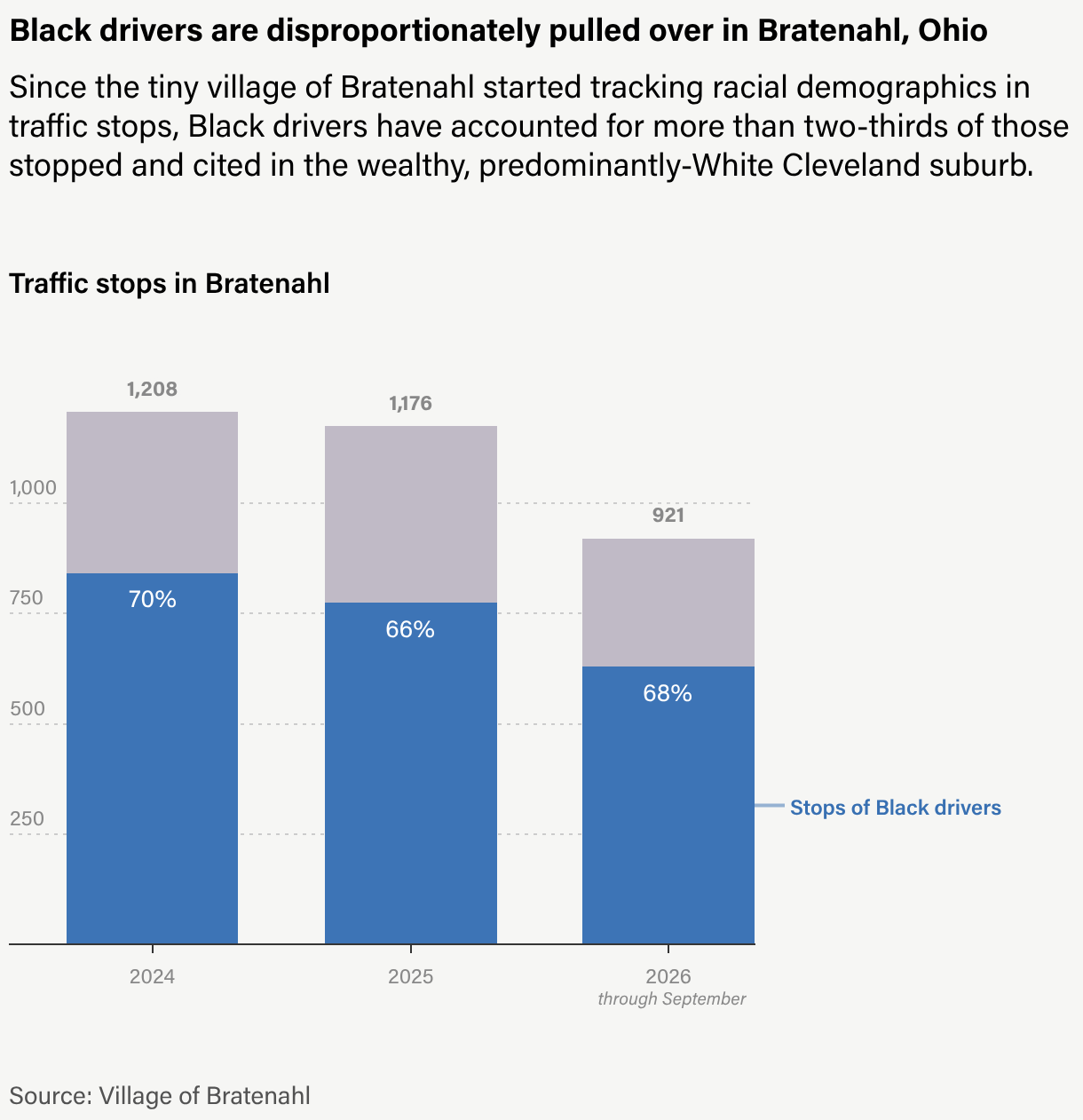
They now have definitive proof: Black drivers have been stopped and ticketed more often than White drivers as they traveled through the village since 2024, according to traffic stop data gathered by The Marshall Project - Cleveland.
Officers sporadically tracked stops and citations in 2023, but began doing so comprehensively in 2024 and underwent mandatory anti-bias training after a 2022 Marshall Project - Cleveland investigation found racial disparities in traffic enforcement.
In 2024, Black drivers accounted for approximately 70 percent of traffic stops and of citations. In 2025, they made up roughly 65 percent of both. Through September of this year, those numbers returned to roughly 70 percent, according to the village records.
Since 2024, the village has collected close to $400,000 in fines, court costs and other revenue from the Mayor’s Court, which primarily handles traffic violations, records show.
The 1,400-resident village of waterfront estates and mansions, including one recently purchased by pop superstar Taylor Swift and NFL star and Cleveland Heights native Travis Kelce, is notorious among Clevelanders. For decades, they said officers targeted Black drivers to raise revenue, and nicknamed the citations the “Bratenahl tax.”
Cleveland Councilman Kevin Conwell, who represents areas near Bratenahl, said he was stunned and “so disappointed” at the numbers since the village’s mayor had pledged to curtail the stopping of Black Clevelanders.
“I am not happy about this,” Conwell said, adding that he wants to meet with Mayor Keith Benjamin. “This must stop.”
Bratenahl officials, including Benjamin and Chief of Police Charles LoBello, have said officers do not racially profile drivers. Benjamin acknowledged recently that the data doesn’t bode well for the village’s reputation and said he took the concerns seriously.
The mayor vowed to do a thorough review of the stop data.
“Racial profiling is unacceptable, and a concern about it deserves a careful, respectful review,” he said. “Even when the facts have not yet been established, the perception of unfair treatment matters because it affects people’s trust in our police and our community.”
Benjamin suggested this type of analysis needed to take into account the race of the tens of thousands of drivers who pass through the village daily on Interstate 90.
“That’s an important missing piece,” Benjamin said. “We need to understand the traffic population as well as the decisions officers make.”
During a recent visit to Mayor’s Court, the majority of the attendees were Black or Hispanic residents of other cities.
“There’s no type of justice here,” Eon Fawcett said Sept. 29, after leaving with $345 in fines, fees and court costs for speeding and not using a turn signal.
“People just get screwed here. Everyone is found guilty.”
The village’s officers patrol side streets and a 3-mile stretch of Interstate 90 that runs along the village’s southern edge.
In late 2022, the police force did not record the race of drivers stopped by officers, and The Marshall Project - Cleveland analyzed records from Mayor’s Court to estimate that the majority of those stopped were Black residents.
As a result, LoBello ordered officers in early 2023 to log the race of all drivers in traffic stops.
LoBello, the most tenured officer on the force, stressed that officers do not use race as the reason for the stops. If the department were doing improper policing, the number of Black drivers being stopped would have decreased after the scrutiny, he said.
“It is truly based on the demographics of people who drive through the village,” he said. “The numbers have been consistent the past four years.”
Bratenahl is surrounded by Cleveland and shares a ZIP code with Glenville, one of Cleveland’s poorest neighborhoods — hundreds of feet away from towering iron security gates, privacy fences and opulent yards.
Chief executives, professional athletes and team owners have called the village home. While they pay property taxes, many of the wealthiest residents do not live there full-time, prohibiting the village from collecting income taxes.
Earlier this month, Bratenahl drew national headlines when Swift and Kelce became its newest residents.
Kelce purchased the 3.5-acre property for $5.35 million in March, months before marrying Swift. News reporters swooped in to paint picturesque scenes of the village, but none mentioned the decades-old friction over disproportionate traffic stops.
On Sept. 29, after leaving the court with a $260 payment plan for speeding and expired plates, Cleveland resident Brandon Shelley said the traffic stops in the village are a fact of life that will not change.
“This goes on in our world on a daily basis,” he said. “I just put my hands up and live.”