This is The Marshall Project’s Closing Argument newsletter, a weekly deep dive into a key criminal justice issue. Want this delivered to your inbox? Sign up for future newsletters.
Ursula Gomez paid her dues to the state of California, spending over two decades in prison, where she immersed herself in rehabilitation programs and went to college.
Her sentence came to an end in July 2024. But instead of letting her go home, the prison system turned her over to Immigration and Customs Enforcement. For 11 months, Gomez was transferred to multiple detention centers, where she said her mental health deteriorated. By then, President Donald Trump was in office and deporting people to countries they hadn’t come from like El Salvador and South Sudan. With that threat hanging over her head, she agreed to be removed to Mexico, the country she and her family left when she was 5.
Gomez was deported later that year.
“I have no ties to Mexico,” she said over a video call in March. “It’s extremely difficult because I’m alone.”
Gomez became trapped in what’s known as the prison-to-ICE pipeline, a practice critics call “double punishment.”
When ICE identifies a person in a prison system or local jail for deportation, the agency typically issues a detainer, or a request to hold the person for transfer to ICE. It is not mandatory and differs from a judicial warrant, which is signed by a judge.
State corrections agencies don’t have to honor these detainers, but the vast majority do so, as does the federal Bureau of Prisons. Thirteen states, including Louisiana and Oklahoma, do so formally through what’s known as a 287(g) agreement, according to a list published by ICE.
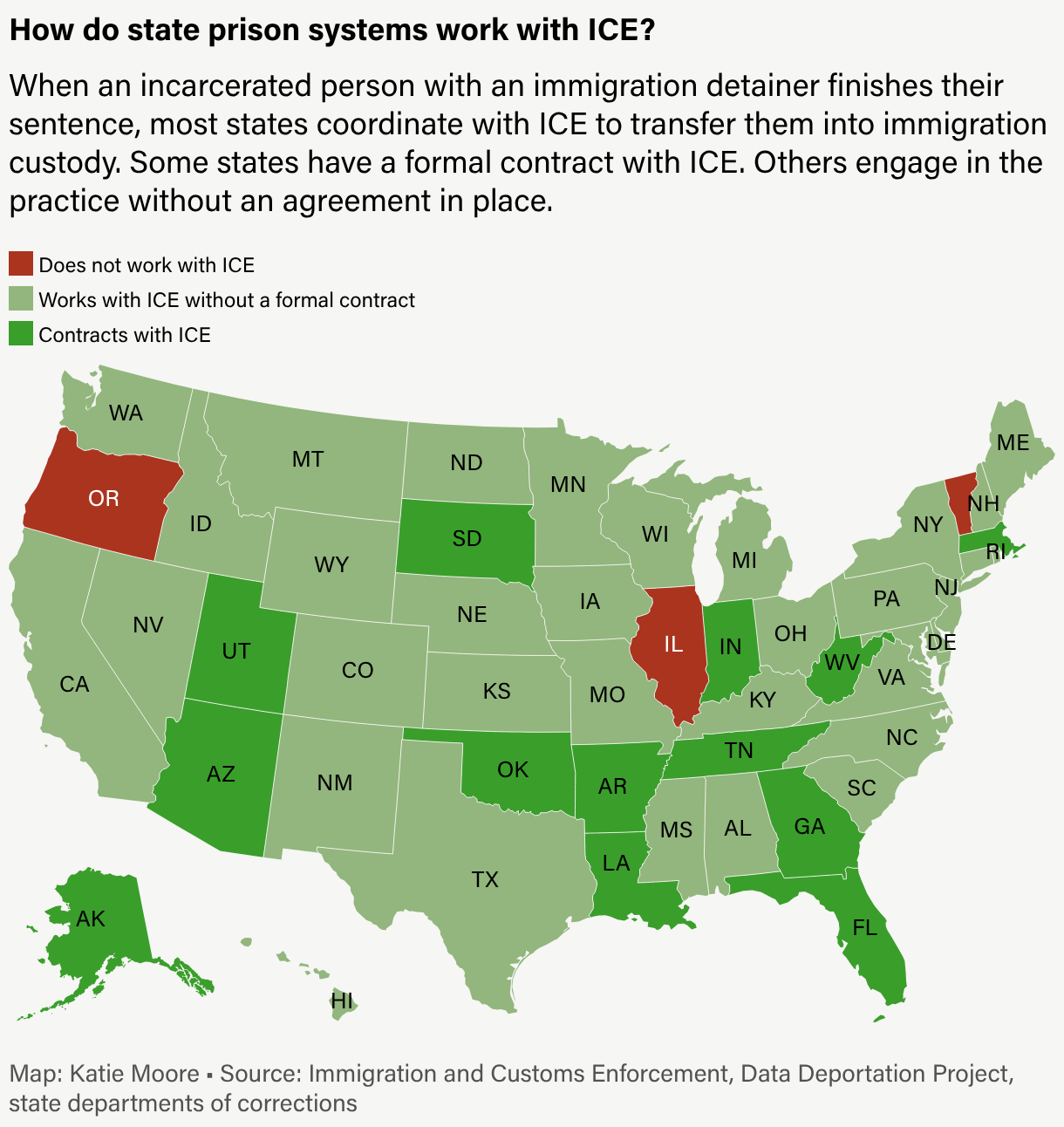
More than 30 other state corrections agencies — like the California Department of Corrections and Rehabilitation (CDCR), where Gomez was incarcerated — don’t operate under a 287(g) agreement, but still transfer people to ICE, according to information from the Deportation Data Project and analyzed by The Marshall Project.
Only three states, Illinois, Oregon and Vermont, explicitly refuse to hand people over to ICE if they are leaving state prison with an immigration detainer, according to those state corrections systems.
Not every crime is a deportable offense, but broad categories encompassing “aggravated felonies” and “crimes of moral turpitude” — such as some DUIs — mean many people leaving prison become entangled in the prison-to-ICE pipeline, which has existed for many years. Even in many cases that don’t involve a deportable offense, immigrants may be flagged to ICE.
Advocates for immigrants say the practice is more troubling under the Trump administration and its aggressive policies, which have contributed to deteriorating conditions at detention facilities and serious due process violations.
California, with its big prison system and large immigrant population, is a good case study of this issue. Many people consider California a sanctuary state, in part because of a 2017 law limiting cooperation between local police and federal immigration authorities. But that measure didn’t include the state prison system. In fact, state law requires that prison authorities identify people who may be subject to deportation and to coordinate custody transfers with ICE.
Since 2015, more than 18,000 people leaving California prisons have been taken into ICE custody, according to CDCR data.
The corrections department seeks to identify people born outside the U.S. when they enter prison, according to its policy. That includes those who have been naturalized or have other forms of legal protection, such as asylum status or a green card.
The CDCR can place a “potential hold” on anyone foreign-born, even if records show they are a citizen, according to an ongoing lawsuit filed by the ACLU of Northern California. The sweeping policy leads to an inquiry with ICE, which makes immigration determinations.
Prison officials have at times placed these holds based on a person’s name, accent or physical appearance, the lawsuit alleges.
CDCR press secretary Terri Hardy said the department provides a consent form informing people that they can decline ICE interviews or have an attorney present. However, the San Quentin News, which is produced by people who are incarcerated, notes that about 70% of incarcerated adults have low literacy.
Laura Hernández, executive director of Freedom for Immigrants, said many incarcerated people don’t understand their rights when it comes to their immigration cases. The organization has helped connect people to immigration attorneys, better understand their avenues for relief and, in some cases, prepare them to get transferred to ICE.
Edwin E. Chavez, 50, was 12 when he came to the U.S. from El Salvador. He is incarcerated at San Quentin State Prison on a conviction for attempted murder. He has gained an education, and learned about trauma while reflecting on his actions. He has also become a prison journalist and a mentor to others.
Chavez thinks California should pilot a program allowing those who have engaged with meaningful rehabilitation work and who meet certain criteria to have a chance at joining their communities under supervision.
Like Chavez, Marlon Melendez came to the U.S. from El Salvador as a young boy.
Now 45 and incarcerated with an ICE hold, Melendez too wants to avoid being sent back to a country known for its human rights abuses. When he went before the parole board in December 2024, he chose an unusual option: He said he was not yet ready to return to society. Prison records show he “stipulated to unsuitability for 3 years.”
His next parole hearing is in 2027. Melendez said he isn’t sure what he is going to do.
Leesa Nomura, an advocate with the California Coalition for Women Prisoners, said the risk of being turned over to ICE has led some people to act out to intentionally prolong their sentences.
Even when a criminal conviction is tossed out, people can end up in ICE’s dragnet. A California man interviewed by The Marshall Project, who did not want to be named out of fear of jeopardizing his immigration case, said he thought he’d walk out of prison after his sentence was commuted in 2018. Instead, he was shackled, put in a van and taken to an ICE processing center. He had arrived in the U.S. as a young boy with refugee status and had a green card. After spending close to a year in ICE detention, he was released as his immigration case continued through the courts. In the following years, he started a family and got a job. After a series of criminal justice reforms, the courts vacated his conviction last year. But ICE has not recognized that his case has been cleared from the record and a final deportation order is still in effect.
“It’s still a legal battle, but I have faith,” he said.
Historically, ICE hasn’t picked up everyone with a detainer. Immigration advocates said if the prison was farther from an immigration field office or someone was being released on a weekend, their chances of being handed over decreased. The rate at which ICE picks up people with an immigration detainer in California prisons dipped under President Joe Biden, hitting a low of 72% in 2022. By last year, it increased to 88%.
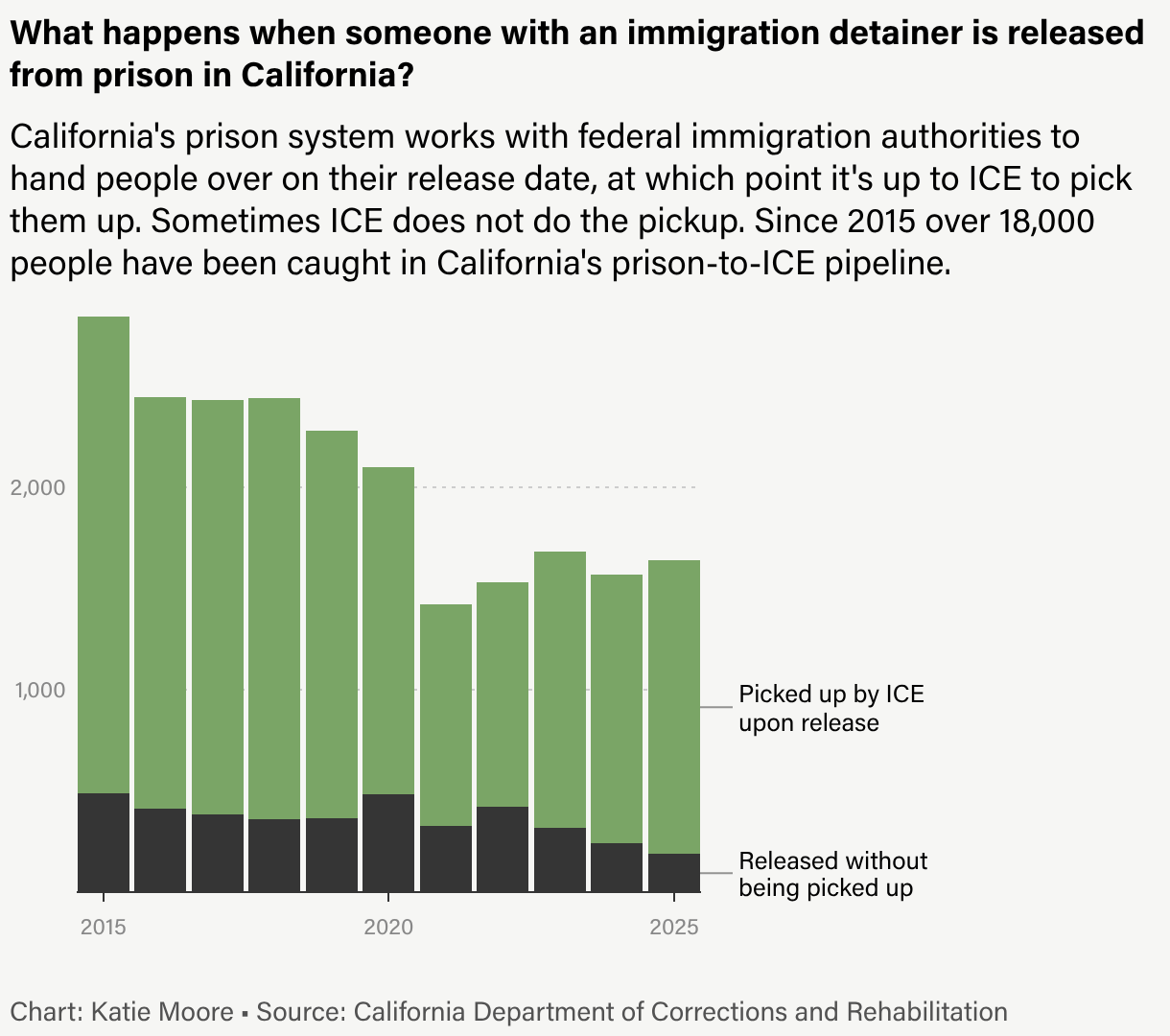
While someone is not supposed to be held beyond their scheduled release date, CDCR’s policies say the date can be moved up in order to release the person to ICE.
In neighboring Oregon, the policies look much different, due to a law passed in 2021. The Oregon Department of Corrections generally does not collect information about a person’s immigration status. In some cases, when the agency needs to verify employment eligibility or file for Medicaid benefits, it obtains citizenship information. But state law prohibits disclosing that information to immigration authorities in most cases. Areas at prisons that are closed to the public are also off-limits to ICE agents, Department of Corrections spokeswoman Amber Campbell said.
A coalition of activists and lawmakers in California attempted to sever the ties between CDCR and ICE through two sets of legislation that would have created similar protections to Oregon’s. One of the proposals made it to Gov. Gavin Newsom’s desk in 2023, but he vetoed it.
Newsom’s office said California’s laws prioritize public safety, crime victims and community trust.
“We’re equally committed to a justice system that emphasizes rehabilitation, second chances, and giving people the opportunity to turn their lives around,” spokesperson Diana Crofts-Pelayo said in a statement.
Advocates say one version of that second chance — where people get to reintegrate into the familiar communities they left — is cut off for those transferred into ICE custody.
Gomez, the woman who was deported last year after her sentence ended in 2024, said if the California legislation had passed, she’d likely be in the U.S. today.
Instead, she’s trying to adapt to life in Mexico. She’s had to figure out basic tasks like how to get an ID card in a new country — while adjusting to life beyond incarceration. In prison, you live differently, Gomez said, and no one around her understands that transition. Being so far from family and other loved ones has been emotionally difficult.
“I don’t know how to be successful here,” she said.
Gomez hopes to return to the U.S. based on the case that landed her in prison in the first place.
In 2003, she was with her boyfriend as he robbed a man and pulled a gun on him. The man responded by shooting and killing her boyfriend. She was convicted of felony murder. Through California’s sentencing reforms, her sentence was reduced and Gomez is working to get the conviction vacated.
For now, as she works on her case from afar, she is also involved in efforts to support other people who have been deported and help them transition to life in a new country.
Correction: An earlier version of this story listed an incorrect conviction for Edwin E. Chavez. He is incarcerated on a conviction for attempted murder.