Warning: This story contains detailed descriptions of the manner of suicide in prison.
Nearly three months into a 10-year sentence for a drive-by shooting, Denise Short asked prison staffers at Central Mississippi Correctional Facility in Pearl to place her on suicide watch. The 21-year-old mother had planned to take her own life, she told them in March 2024.
Prison officials ignored Short’s request, which would have required frequent well-being checks and other moves to keep her from harming herself. Instead, they locked her in what the department calls a “segregation” cell, or “restrictive housing”— or what is more commonly known as solitary confinement, according to a lawsuit filed by her family. She was left alone behind a steel door with a narrow sliver for a window.
A day later, correctional officers found Short’s body hanging from a state-issued bedsheet, the lawsuit alleges.
“There were so many opportunities to help Denise,” said Jenessa Hicks, a lawyer representing Short’s family. But at every turn, said Hicks, Short was denied the help she needed.
Short is one of at least 47 people who died by suicide while in restrictive housing units in Mississippi’s prisons between 2015 and 2025, according to an investigation by The Marshall Project, Mississippi Today and the Clarion Ledger. The team reviewed prison housing histories, disciplinary records, death incident reports, police records, lawsuits and autopsies.
Among the findings:
-
Nearly 75% of the incarcerated people who died by suicide were housed in restrictive housing units, where well-being checks are supposed to happen more frequently than in the general population — twice per hour, no more than 40 minutes apart. In some cases, rigor mortis had set in by the time a person was found, signaling that they had been dead for hours.
-
Many of the incarcerated people who killed themselves had a history of self-harm or previous suicide attempts that were known to prison officials.
-
The Mississippi Department of Corrections continues to use solitary confinement to house people who are diagnosed with mental illnesses, despite national studies, federal lawsuits against the agency, and United Nations testimonies that show the practice heightens the risk of suicide and worsens mental health conditions. Solitary confinement can also trigger mental health issues in people who have not been previously diagnosed.
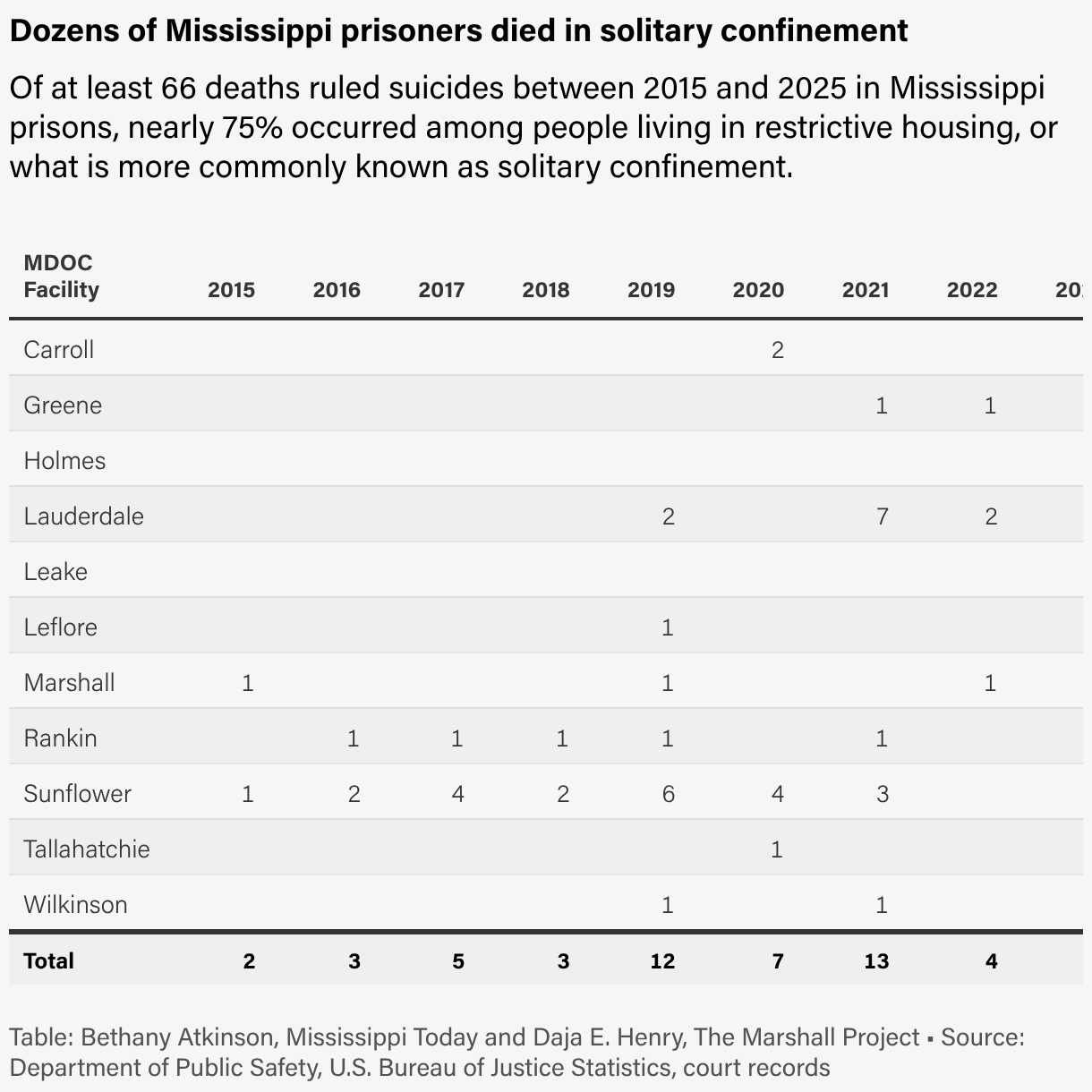
According to MDOC's standard operating policies, placement in restrictive housing — what the Justice Department defines as any housing condition where someone is locked in a room alone or with one other person for the vast majority of the day — can only be used when someone poses a risk or threat to themself, others, staff, facility security or property, or has committed a major rule violation such as violence, gang activity or possession of contraband.
Before someone is sent to restrictive housing, a medical staff member is supposed to review an incarcerated person’s medical record for any conditions, including those related to mental and physical health, “that could be detrimental to confinement,” according to MDOC policy.
MDOC spokesperson Kate Head said the department uses restrictive housing “as a last resort for housing an inmate who poses a threat to themselves, property, staff, other inmates, and/or the operation of the facility.”
Nationwide, half of all suicides in prisons and jails occur in solitary confinement, according to the National Alliance on Mental Illness.
A 2024 study found that solitary confinement increased the likelihood of suicidal ideation, even more than incarceration without solitary confinement. Another 2021 study in the Lancet Journal listed occupation of a single-person cell and no social visits as risk factors contributing to the heightened risk of suicide. The practice has also been linked to self-harm, chronic stress, anxiety, trouble sleeping and difficulties with memory and concentration.
Solitary confinement is especially harmful to people with mental illnesses, said Terry Kupers, a forensic psychiatrist and nationally recognized expert on solitary confinement. It is often used to warehouse difficult incarcerated people whom corrections staff don’t know how to handle, he said.
“The more inadequate the mental health treatment in a correctional system, the more people with mental illness are sent to solitary. It’s just a matter of convenience,” Kupers said.
The United Nations and the National Commission on Correctional Health Care both state that solitary confinement should never exceed 15 days. At one Mississippi facility, incarcerated people classified as “close custody” stayed in restrictive housing for an average of 515 days, a 2022 investigation by the Justice Department found. One man who died by hanging had been in solitary confinement on death row for 20 years.
Mississippi is “unfortunate, but not alone,” in its continued use of solitary confinement, Kupers said. He has testified as an expert witness in multiple lawsuits against the state, including one that resulted in the 2010 closure of a solitary confinement unit at the Mississippi State Penitentiary at Parchman.
Other prison systems in the Deep South have grappled with the use of solitary confinement and its impact.
A class action lawsuit over a solitary confinement program led to Georgia State Prison being shut down in 2022. The facility, which specialized in housing and caring for those with serious mental illness, was the site of nearly one-third of all suicides in the Georgia corrections system, according to the Southern Center for Human Rights, which represented the incarcerated people in solitary.
In Alabama, a federal judge ruled in 2017 that mental health care in the state’s prisons was “horrendously inadequate” and violated the Eighth Amendment against cruel and unusual punishment. At the time, the state’s prison suicide rate was four times the national average.
The Justice Department sued Alabama over numerous constitutional violations in its prisons. The state responded by increasing funding to the corrections system and embarked on building a $1 billion prison that is expected to be complete this year.
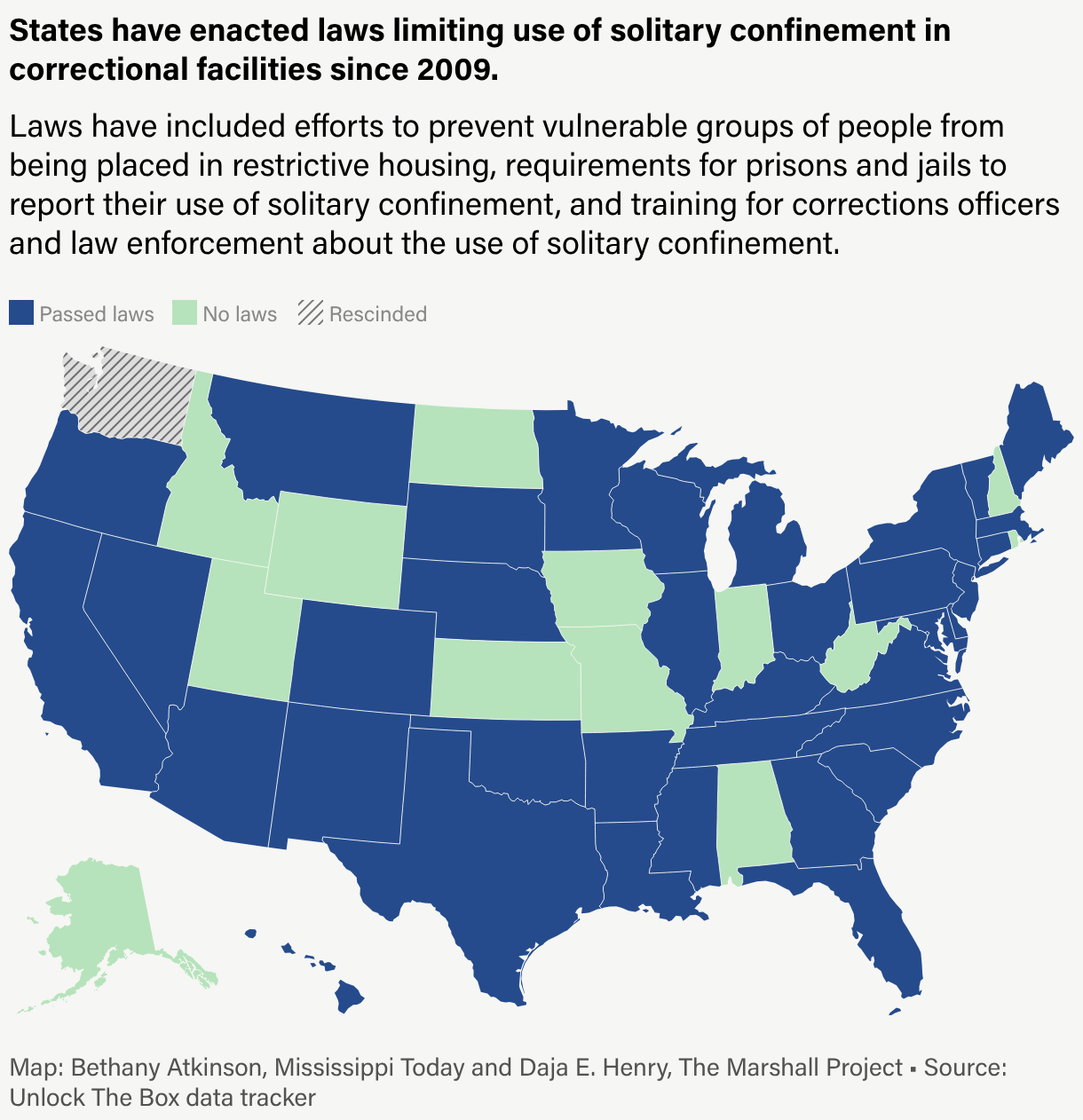
Since 2009, nearly 40 states have enacted legislation to limit solitary confinement for adults and juveniles in prisons, jails and youth detention. The one law passed by Mississippi on limiting solitary confinement is narrowly focused on pregnant people. Passed in 2021, it states prison staff can’t place them in solitary unless there is a reasonable belief they may harm themselves or the fetus, or they are a flight risk.
To date, no state has fully ended the use of solitary. Washington banned its use in private detention facilities in 2023, only to undo that law two years later.
States have been successful in enacting laws to prevent vulnerable groups of people from being placed in restrictive housing, including those with serious mental illness, those who are pregnant or postpartum, and those who are caring for children. Other laws have required prisons and jails to report their use of solitary confinement and training for corrections officers and law enforcement about its use.
The torturous conditions in Mississippi’s restrictive housing units make them “breeding grounds for suicide, self-inflicted injury, fires, and assaults,” a 2024 investigation by the Justice Department found.
“All they do is beat, bang and cry,” said one incarcerated man interviewed by the Justice Department at the Central Mississippi Correctional Facility.
‘Why y’all always refusing me medical treatment?’
Brandon Mitchell cried out for help repeatedly before he died by suicide in solitary confinement at East Mississippi Correctional Facility in Meridian in 2021. EMCF is a privately run facility that incarcerates prisoners with mental illnesses. Approximately 75% of residents at the facility have a diagnosed mental health condition, according to Emily Lawhead, a spokesperson for Management & Training Corp., which operates the prison.
For nearly three years, Mitchell was in restrictive housing for all but two weeks. He was otherwise shuffled between a medical unit and camp support, a smaller unit for people needing acute mental health treatment.
Two weeks before his death, a mental health nurse wrote in her notes that Mitchell was acting out “all to get attention.”
For at least 10 months before his death, Mitchell had recurring mental health episodes, according to a lawsuit filed on behalf of his estate. He cut his arms. He set fires. He broke his cell window. He tied a jumpsuit around his neck. He was kept in solitary. He told security and mental health staff that he was suicidal, asked for medication and to be taken out of his cell. He said he felt like he wasn’t being taken seriously.
“Why y’all always refusing me medical treatment?” he asked a nurse, according to the lawsuit.
Self-harm is a psychiatric emergency, Kupers said. In prison, behaviors that could be manifestations of mental illness are treated as disciplinary violations, making it harder for those in solitary confinement to get out, and perpetuating what Kupers called a “vicious cycle” of despair.
“People tend to self-harm, go to suicide watch for days or a week, and get sent back to solitary,” Kupers said. “A suicide crisis is not over in a few days.”
A review of disciplinary reports for self-harm showed incarcerated people cut themselves with razors, glass and other sharpened objects; swallowed batteries; and attempted to hang themselves with clothing or bedsheets — all while they were supposed to be under supervision.
These acts of self-mutilation were punished with loss of canteen or telephone privileges, isolation and restitution — requiring the incarcerated person to pay for medical expenses.
The frequent self-harm episodes are also indicative of security failures that make it easier to carry out a suicide.
“The idea that a person is in segregation and is actively asking for help, and the response, oddly enough, is to further isolate the person, is really a head-scratcher for me,” said Andrea Armstrong, a nationally recognized researcher on deaths in custody.
Preventable deaths, including suicides, happen when prisons fail at their core functions, Armstrong said. These responsibilities include attentive supervision, services such as mental health treatment and security around the facility’s outside perimeter.
Consistent understaffing, poor recordkeeping that improperly places people in restrictive housing, and lax oversight that allows illegal drugs to flow through the system all contribute to these failures, making it easier to die by suicide or homicide in these facilities.
MDOC policy requires frequent checks on people who are in restrictive housing, especially those who are “violent or mentally disordered or who demonstrate unusual or bizarre behavior.” The policy also states that those who are suicidal should be under continuous observation.
Chronic understaffing often prevents checks with that frequency.
The Justice Department’s 2024 investigation found that the Central Mississippi prison, where Short would later die, was operating with less than half the staff needed. The state auditor’s office is demanding a $7.4 million penalty from the private company that runs EMCF, where Mitchell died, for failure to provide the minimum mandatory staff to run the prison, as a 2020 investigation by The Marshall Project revealed.
The Justice Department’s 2022 investigation at Parchman, another Mississippi facility, revealed that some corrections officers had falsified count sheets, claiming that they had done security checks when they had not.
In the absence of staff, some — like Mitchell — resort to extreme behaviors, such as setting fires and self-harm, to draw staff members’ attention to the largely unsupervised units.
When staff are present, they serve as de facto gatekeepers to health care. In order to see a medical professional, incarcerated people have to fill out a “sick call” form, which is handled by corrections officers.
Those sick calls are sometimes ignored, said attorney Greta Kemp Martin, formerly with Disability Rights Mississippi. The organization monitored Mississippi prisons and filed a lawsuit in 2021 against MDOC, corrections staff and VitalCore, the department’s private healthcare contractor, alleging inadequate medical care.
Corrections officers, who are not trained mental health professionals, are the first responders to psychiatric emergencies.
In a 2020 self-harm incident documented in an MDOC rule violation report, a corrections officer ordered an incarcerated person at EMCF to stop cutting himself. When the prisoner did not stop, the officer sprayed him with a chemical. He was then punished with a 30-day loss of all privileges.
“Even when you are imprisoned for committing a crime, you still deserve to be treated with basic human dignity and not completely disregarded and have your cries for help be totally ignored,” said Hicks, the lawyer representing Denise Short’s family.
Short’s lawsuit alleges that when she notified one MDOC employee of her suicidal thoughts, the employee responded, “Do what you have to do.”
MDOC denied that, according to the lawsuit.
At the Central Mississippi Correctional Facility where Short died, her family’s lawyer alleges major discrepancies between what prison records show about the timing of her check-ins and her death and what video evidence shows. Short was last seen alive between 4 p.m. and 5 p.m. on March 19, 2024, her family’s lawsuit alleges. An MDOC employee says they saw her through a narrow cell door window at 6 a.m. the next day and believed she was standing. But lawyer Jenessa Hicks said video evidence shows that Short was already hanging by that point. She was discovered dead at 8:20 a.m. that same day.
The news team requested logs that would reveal if anyone checked on Short in the hours leading up to her death, but MDOC did not provide them by the time of this publication.
Mitchell's case also raises serious questions about the frequency of check-ins. When he was found dead in his cell on the morning of April 24, 2021, his body was cold and stiff. Rigor mortis had set in.
Grant McLaughlin, who now works for Lagniappe Daily, has continued working on this project since he was a reporter at the Clarion Ledger.