If someone you know is incarcerated and at risk for suicide or showing suicidal tendencies, reach out to their attorney or an advocate who can notify the facility's mental health unit.
ST. LOUIS - They were all held at the St. Louis City Justice Center, waiting for their day in court.
One, 32 years old, died of complications from his untreated diabetes, the city medical examiner’s office concluded. Another, a year older, hanged herself in her cell, dying days later from a lack of oxygen to her brain, according to her autopsy report. A third, 31, died from what the city said was an overdose, but his family called it negligence by the jail’s employees.
Their cases were among at least 22 deaths at the jail since 2020, and 49 overall since the six-story facility opened in 2002. A review of death records by The Marshall Project and St. Louis Public Radio shows the reasons the three died weren’t aberrations: The most common causes were untreated medical conditions, drug use and addiction, and suicide.
The review’s findings help underscore the problems city officials, jail administrators, medical staff and law enforcement officers have long struggled to solve, including poor medical and mental health care, inadequate staffing and gaps in the monitoring of vulnerable detainees.
“The city needs to get its act together about the culture at the city jail. It’s just so dangerous,” said Dr. Fred Rottnek, a community medicine professor at St. Louis University and former medical head of the St. Louis County jail. He added that until city officials can meaningfully address the challenges plaguing the jail, “I wouldn’t send anybody to work in that facility.”
The City Justice Center has been St. Louis’s only jail, after a second facility known as ”The Workhouse” was demolished in 2025, following a years-long campaign to close it due to hazardous conditions, including rats, roaches, mold and extreme heat. However, conditions at the current jail have also raised alarm, including faulty locks that have allowed detainees to escape their cells, lack of access to sunlight and fresh air for weeks, and a shortage of basic hygiene supplies such as soap or sanitary pads.
In recent years, the jail has also been plagued by high turnover in leadership; current commissioner Nate Hayward is the jail’s fourth leader in two years, including multiple interim heads. Since starting in September 2025, Hayward has had to contend with a detainee population that has crept steadily upward in recent years, even as the number of corrections officers dwindles.
Multiple lawsuits against the jail in the last year allege some staffers have ignored pleas from detainees desperate for help, including one in which the city has refused to represent its own employees. Two people have died at the jail since Hayward stepped into the role, including one in January 2026.
Dr. Joseph Young, who treats patients from the jail, said he’s noticed a trend of detainees self-inflicting injuries in a desperate attempt to seek treatment.
“People, for example, [are] swallowing razor blades, but the razor blades are covered in tape. But on the X-ray, it just looks like an unprotected razor blade… which could be fatal,” said Young, an assistant professor of medicine at St. Louis University. “It seems like their goal was to come to the hospital, and I can understand why they’d rather be here than the jail.”
Protests calling for a dramatic decrease in the jail’s population persist, with advocates insisting that a reduction is essential to eliminating deaths at the facility.
When asked about the city’s plan to prevent deaths at the facility, Hayward said through a spokesman that the corrections division is focusing on reducing deaths by implementing measures to identify and respond to medical and mental health emergencies sooner and increasing coordination between jail employees and medical workers.
Staff should take every plea for help or sign of distress seriously and respond immediately, Hayward said.
For this story, The Marshall Project and St. Louis Public Radio reviewed autopsy records, lawsuits and court documents, as well as interviewed families of those who died, advocates and medical providers to understand how a stay at a facility meant for short pre-trial detainment can turn deadly.


Untreated medical conditions
Advocates and medical providers say jail employees neglect to provide appropriate medical and mental health care to the jail’s population, which means people rarely get the care they need until their condition escalates into an emergency. And once there is a medical emergency, the jail lacks clear protocol on how to address it.
For them, 32-year-old Carlton Bernard’s death is just one example of what can happen when the jail staff fails to adequately monitor the health of those in their care. Bernard was in jail after being arrested in June 2023, according to court records. Records from the medical examiner’s office note that he was pronounced dead at St. Louis University Hospital exactly two months later, from complications of diabetes.
Bernard, who did not receive insulin while inside, ended up developing ketoacidosis, a preventable medical emergency caused by untreated diabetes, according to the city medical examiner’s office.
In the months after his death, the medical examiner said they found no diabetes diagnosis in Bernard’s medical history, raising the possibility that neither he nor the city were aware of his medical condition. It’s possible, the office said, that the condition may even have developed while he was in jail.
Advocates for Bernard’s family, however, emphasized that it was nevertheless the responsibility of jail employees to notice his deteriorating condition and provide him the appropriate care.
“ For Carlton Bernard to die from not receiving his insulin, that means days — if not weeks — of not receiving medication,” said Mike Milton, executive director of the community organization Freedom Community Center, which advocates for the families of people held at the jail.
“That’s the culture of how [staff] view people who are accused of crimes: They just neglect them,” he said.
According to Milton, the Freedom Community Center documented roughly 150 instances in the last year where a circuit judge ordered jail officials to provide adequate medical care for detainees.
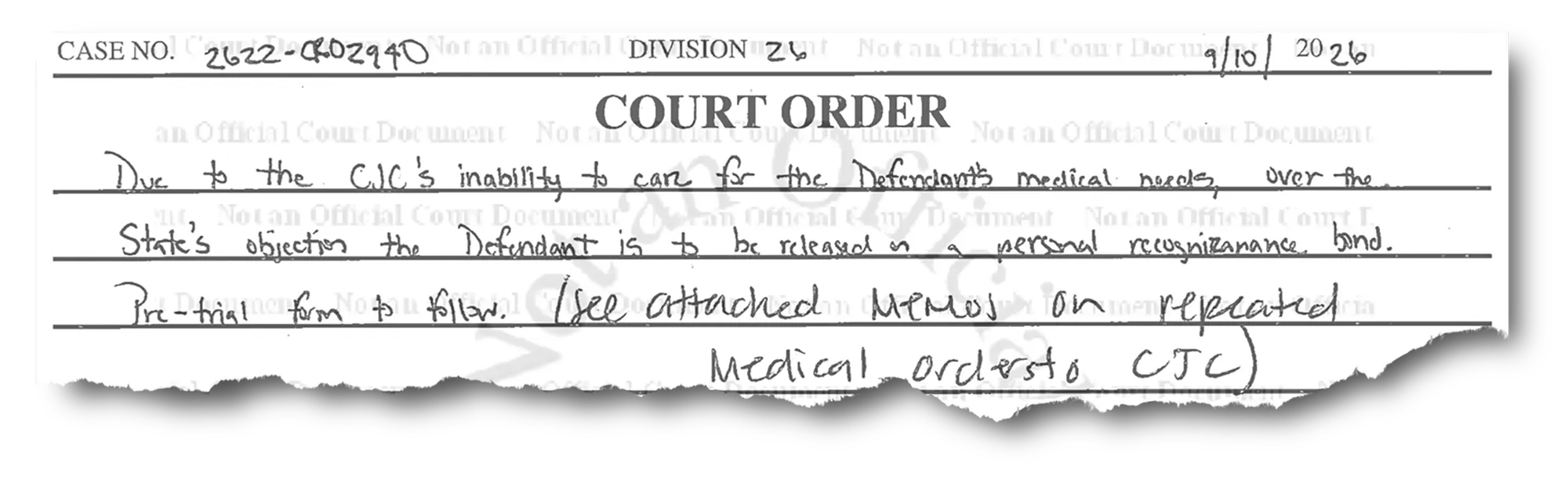
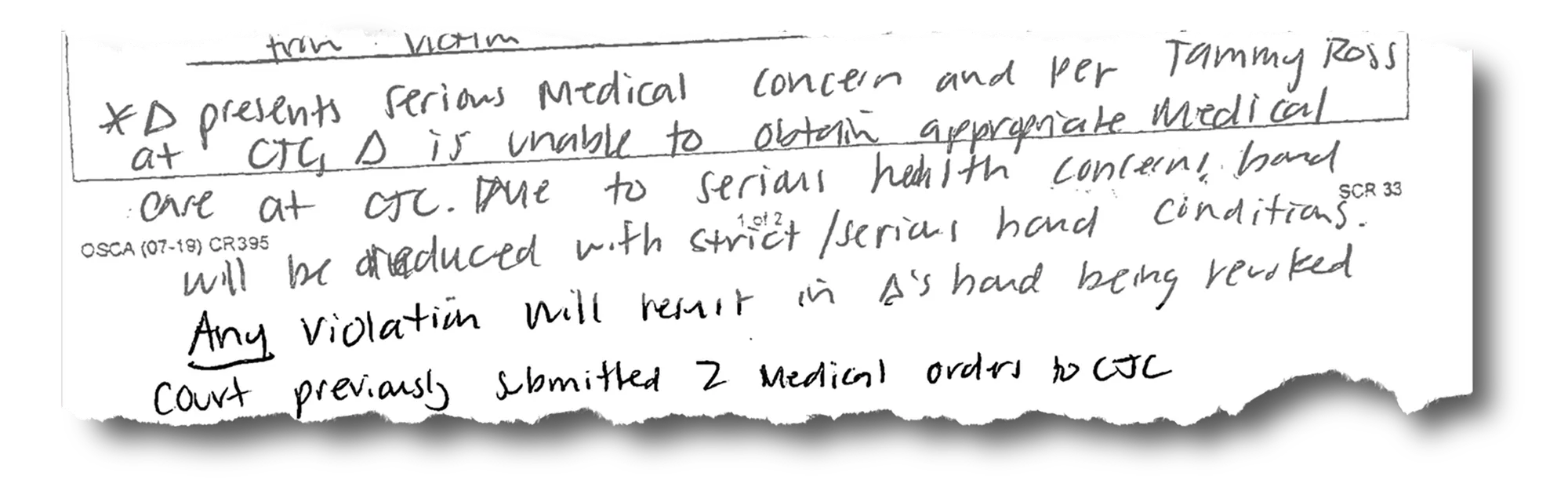
In a Sept. 10 court order, a judge ordered the jail to release someone “due to the CJC’s inability to care for the defendant’s medical needs.” Another court order calling for reduced bail cited the jail’s deputy commissioner Tammy Ross, noting the defendant “is unable to obtain appropriate medical care at CJC.”
Jail spokesperson Bretton DeLaria said Hayward supports releasing detainees “when medically necessary and when the Division of Corrections is unable to adequately meet their medical needs within the facility,” adding that the jail “has worked and will continue to work with the courts to seek consideration for compassionate release when appropriate.”
Rottnek, the former medical head of the county jail, said he has repeatedly turned down offers to lead the city jail’s medical team, in part because he believes jail administrators have failed to provide consistent protocol for how to care for the people in their custody.
“They say they have standards, but they don’t have a policy or protocol, or any evidence to show they’re carrying it out,” he said. “Nothing.”
The jail’s “inmate handbook,” which is supposed to outline its policies and was last updated in 2020, was taken offline in April 2026 and has yet to be replaced. DeLaria declined to specify when a new handbook will be available but said the corrections division “is reviewing and updating the inmate handbook to ensure that it accurately reflects current facility policies and procedures.”
Drug use and addiction
Multiple doctors at St. Louis University Hospital, which receives many patients from the jail, said the facility lacks a clear policy for handling people with addiction and that current practices fall short of the guidelines set by the American Society of Addiction Medicine.
For example, the jail limits access to medication for opioid addiction, according to Dr. Dylan Caggiano, a physician and assistant professor of addiction medicine at St. Louis University, even though sudden opioid withdrawal is known to exacerbate underlying medical conditions, causing a heart attack or stroke in patients with heart disease.
The reported manner of death can also obscure underlying conditions or circumstances that contributed to a person’s death. In 2019, two people at the jail whose deaths were recorded by the medical examiner as “natural” causes suffered from deadly heart conditions triggered by opioid withdrawal, according to data from the examiner’s office.
Deaths labeled “accidents,” meanwhile, are most often fatal drug overdoses, which Rottnek said is typically the result of employees allowing contraband drugs to flow into the jail.
“ When somebody’s arrested, if they had problems from substances they used before they were arrested, what they’re going to suffer from is the detox process. They’re not overdosing,” he explained. “If somebody dies from an overdose, especially somebody who’s been there more than 24 hours, you can pretty much be assured that that is from contraband being brought in.”
DeLaria said the jail supports continuity of care, “particularly for individuals who enter custody with existing medical conditions or prescribed treatment regimens.”
However, Caggiano said jail employees told him this summer that detainees who enter the jail with an opioid addiction can only receive medication if they test negative for all other substances during intake. Otherwise, “they’re forced to withdraw from everything, and their Suboxone is not continued,” he said, referring to a medication that helps reduce withdrawal symptoms.
Jail employees pointed to understaffing as the reason for the policy, Caggiano said, and that even patients who do receive medication get a lower dose than prescribed: once a day, for example, instead of three times a day.
Caggiano said the jail’s current policy is not in line with either national medical or corrections’ best practices for how to treat patients struggling with a prior addiction. Medication “should be continued across the board, 100%, unless the patient has decided that they don’t want to take it or there's some side effect,” he said, “so it [the jail’s policy] doesn’t make much sense to me.”
In a September interview, Hayward said employees had been limiting how often they provided medication to detainees because of staffing levels, and he said he’s been working to address the issue.
Mental health
A common complaint across multiple wrongful death lawsuits in recent years was employees ignoring detainees' cries for help until it was too late to save them. These repeated instances of failing to act quickly in moments of crisis are particularly evident in the five suicides that have occurred at the jail in the last six years.
In 2024, Katrina Kelly hanged herself in her cell and was declared dead days later at the hospital, according to her autopsy report. According to a lawsuit her family filed, Kelly, 33, had been in jail for only about 10 days. The complaint cited other detainees who said they knew Kelly was in distress, and had cried out for someone to help her for roughly half an hour to no avail.
“Had Kelly been supervised or tended to in a timely manner… [she] would have survived with no serious medical consequences,” the complaint alleges.
In 2021, Quincy Baker died by suicide in the jail’s “prisoner processing unit,” an intake area at the jail jointly supervised by jail staff and city police. Despite being transported to the jail directly from the psychiatric ward at St. Louis University Hospital with a documented suicide risk, Baker, 39, was left unattended in a holding cell for hours, according to a 2023 wrongful death lawsuit.
Video footage of the intake area viewed by The Marshall Project and St. Louis Public Radio shows an officer closest to Baker’s cell watching a sitcom instead of checking on him. For over half an hour, Baker can be seen at the window to his cell banging on the door for attention, before taking off his shirt and disappearing from view just after 12:30 a.m. Despite multiple officers passing by his cell, it was over an hour before anyone looked into his cell and discovered he had hanged himself.
“They wasn’t watching him. When I heard that the guard was watching TV while he was hanging his self… [it] made me so mad,” Baker’s mother, Sheila, said. Through tears, she described how difficult it was to talk about her son’s death to her daughter, his younger sister. “She said, ‘He was such a nice person. Why they do that to him?’”
The jail’s spokesperson said that in the last year, the facility has strengthened its screening process for identifying people who may be entering the facility with existing mental health conditions, and that people “requiring additional mental health services are referred to the facility’s mental health professionals for further assessment and ongoing care as appropriate.”
Erin Moore, a public defender representing people held at the jail, told The Marshall Project in June that overpopulation and a dire shortage of mental health resources — from access to clinicians to counseling programs — continue to make it difficult for people inside to get the help they need.
“If they had better mental health treatment… and if they had half the number of people in there, I think some things could change,” she said.
Systemic problems at the jail
Baker’s death is not the only instance of cries for help going unanswered by jail employees.
In Samuel Hayes Jr.’s death, the lawsuit filed by his family alleges that jail employees restrained the 31-year-old and two nurses briefly tended to him, but then left him alone while he cried out for about 20 minutes. When another worker arrived over an hour later, Hayes had stopped moving and was taken to St. Louis University Hospital, where he was pronounced dead, the complaint alleges.
And according to the NAACP, Dametria McDile — the most recent person to die in the jail’s custody in January 2026 — was also ignored by staff in the moments leading up to her death, crying out to nurses that she was struggling to breathe. The civil rights group noted in their report that a corrections officer and a nurse were quietly fired following her death.
Families of people who died at the jail have slammed city officials for not being transparent about how exactly their loved ones died, and what happened to them in their final hours. Relatives of the deceased say their pleas to speak with officials have been ignored, while public records requests have gone unanswered.
“ I'm confused why it takes so much and so long, and why no one’s been answering any questions,” said Chereese Weems, a cousin of McDile.
In a statement, DeLaria said when someone dies, the commissioner or deputy commissioner is responsible for notifying next of kin “based on the preliminary information available at the time.” Families are also provided with contact information for the medical examiner’s office, which has the authority to share details about the cause of death.
McDile’s manner of death is undetermined, according to the city medical examiner’s office, which listed the cause of death as cardiac arrhythmia of unknown origin. Weems said she reached out to the jail commissioner, the medical examiner and the mayor, none of whom could answer her questions about what happened to her cousin.
“ We've been trying since the day it happened, since the day she died, and literally had no luck,” Weems added. “Everybody playing games… so yeah, I’m frustrated.”
What we want to know
The Marshall Project and St. Louis Public Radio are still interested in hearing from people who work at the jail or who have recently been released about their experiences at the City Justice Center. We’d also love to hear from people whose family or friends are currently incarcerated. Some questions we’re interested in:
-
What were the conditions like at the jail while you worked or lived there? Did you feel like you received enough resources and/or support?
-
City records report zero COVID-related deaths at the jail in 2020 or 2021. Did you work or live at the jail during the COVID-19 pandemic? What was your experience? Were there adequate safety precautions and medical care available?
-
Have you tried to get records from the jail about yourself or your family member? What was your experience? Who did you speak to? How were you treated?
-
Did you or your family member ever need medical or mental health care while at the jail? Were you/they able to access this care, and if so, how long did it take? How would you describe the quality of care received?
-
Anything else you think we should know about living or working inside the jail? Or what it’s like to work with the jail as an outside partner providing services?
You can reach us with your stories and experiences by writing to stlouis@themarshallproject.org.