As federal agents descend on Chicago this week for a renewed round of immigration raids, a Marshall Project analysis shows what happened to around 1,600 people arrested in a similar operation this fall. Our reporting reveals how federal agencies moved them through the Trump administration’s expanded network of detention facilities — many rife with complaints of inhumane conditions.
The analysis of recently released Immigration and Customs Enforcement data found that Illinois saw the sharpest increase in ICE arrests of any U.S. state in the first five weeks after the blitz began. And those who were arrested were quickly shuttled to a sprawling array of detention facilities that cut a wide swath down the middle of the country.
When federal agents launched “Operation Midway Blitz” in September, they arrested thousands of people, at times near schools or child care centers, and used chemical agents like tear gas on protesters. In response to the often chaotic and high-profile raids, city residents blew whistles to alert neighbors of approaching agents and organized “magic school buses” to accompany children to school.
The Marshall Project analyzed ICE data that includes arrests and detentions through the middle of October, the most current detailed records publicly available. People who ICE arrested during that time were later detained in 13 states, at county jails, privately run detention centers and a rapidly constructed facility on a military base, the data shows.
“Without that infrastructure, without mass detention, you can’t carry out mass raids or mass deportation,” said Stacy Suh, program director at Detention Watch Network, a coalition of grassroots organizations that seeks to end immigration detention.
The ICE data, obtained by the Deportation Data Project, allowed The Marshall Project to trace individuals as they were transferred between facilities, and in some cases, deported.
President Donald Trump has rapidly ramped up immigration arrests in an attempt to deport 1 million people in his first year back in office. At the same time, a new Department of Homeland Security policy denies detainees the right to bond hearings in immigration court, leading the number of people in detention to reach record-highs.
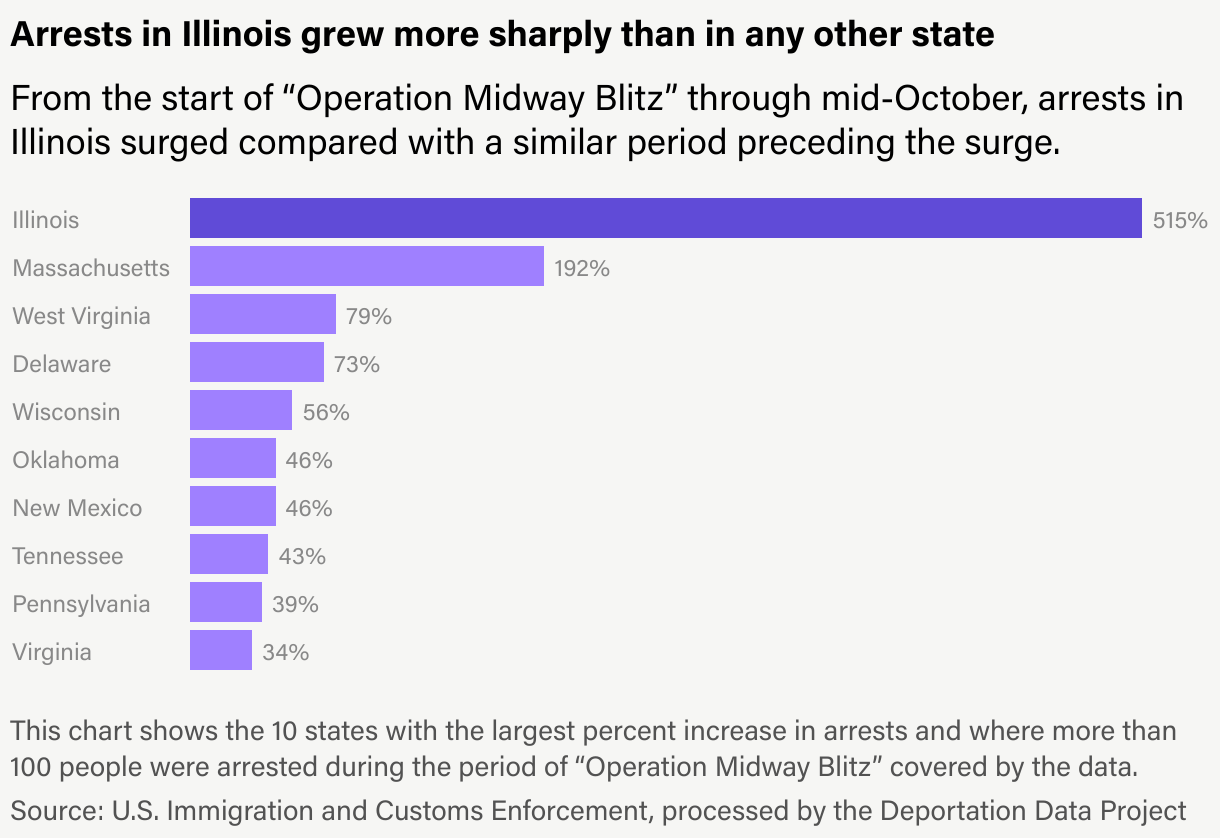
Examining the records of people who were arrested in the Chicago area, The Marshall Project found that nearly all of them were first held at a facility in Broadview, Illinois, a suburb west of the city. In November, a federal judge issued a temporary restraining order compelling ICE to address conditions there.
The order cites “serious conditions” at the facility, similar to those reported at detention centers across the nation, and requires ICE to provide access to sleeping space, bedding, toiletries, medication, regularly cleaned areas, regular meals, telephone calls and clear information about paperwork the government asks detainees to sign.
The suburban facility, which has been the site of a lot of protests against the immigration raids, was the first stop for many who were arrested off the street as federal agents moved through the region. Dayanne Figueroa, a U.S. citizen who was pulled from her SUV by federal agents in a Chicago neighborhood, was detained at the Broadview facility. Figueroa, who was recovering from kidney surgeries when she was taken to Broadview, told Congress that she “begged for help” but was ignored by agents and “thrown into a filthy jail cell,” until blood in her urine prompted them to get her medical care.
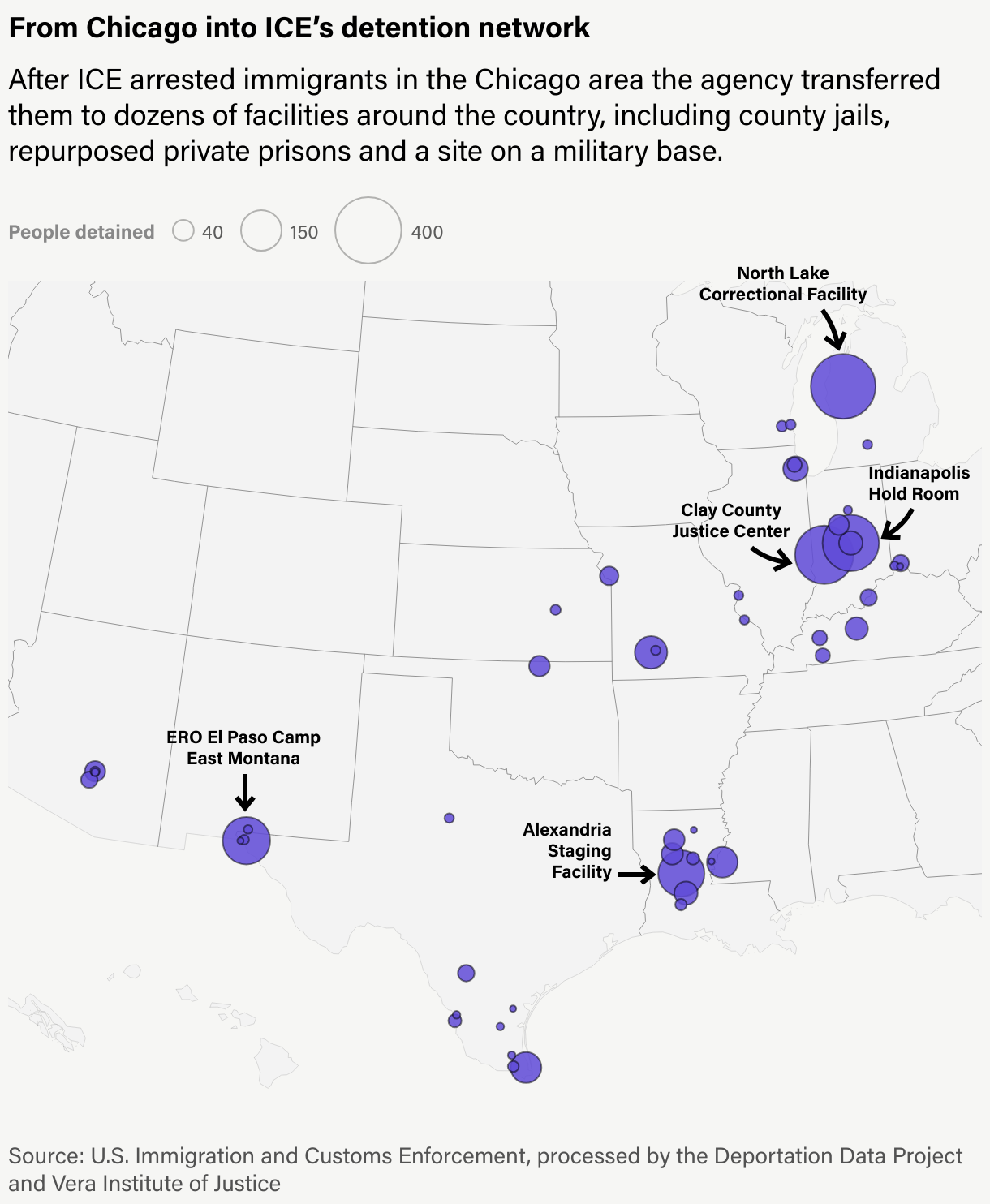
After being booked into ICE custody, more than 380 people arrested in the Chicago area were transported to a recently revived detention facility in the rural town of Baldwin, Michigan. The facility, North Lake Processing Center, tops the list of places where the most people were held in the first weeks of the Operation Midway Blitz raids.
North Lake, which is run by GEO Group, was previously a federal prison until the Biden administration ended Department of Justice contracts with private prison companies. It reopened in June under a new contract with the Department of Homeland Security, becoming the largest immigration detention center in the Midwest.
Nahomi Ramirez, whose father is detained there, said North Lake still looks and feels like the prison it once was.
“It’s concrete walls, it’s barbed wire fences everywhere, like for no one to escape,” Ramirez said. “I haven’t even fully processed that in my brain, to be honest.”
Her father, Fernando Ramirez, a semitruck driver arrested in Indiana, told her he was moved to a freezing-cold, filthy ward with other people who have diabetes. The detainees in the ward were not always fed on time, which caused their blood sugar to crash, Ramirez said, and her father’s allergy to the blankets in his room has left him huddling under his jacket for warmth.
U.S. Rep. Rashida Tlaib of Michigan has reported receiving similar complaints from North Lake detainees about inadequate food, lack of medical care and freezing temperatures, as well as visitation issues, lack of access to legal counsel and suicide attempts. The concerns prompted her to visit the facility.
Since Trump’s second term began, more privately run immigration facilities have opened, or reopened, around the U.S. to keep up with the pace of raids and detentions. Meanwhile, advocates have warned of inhumane conditions for detainees.
Eighteen people, more than half of them children, arrested in the Chicago area were transferred to the Dilley Immigration Processing Center in Texas, run by CoreCivic. President Joe Biden ended the practice of detaining children with their families in 2021, but Trump recently reversed that policy and resumed operations.
Families at Dilley have testified in court filings to troubling conditions, including worms and mold in food and little access to education or recreation for children. They said their children were so distressed that they had hit their own faces and soiled themselves, despite being potty-trained.
In 2021, Illinois banned local jails from supplying detention space to ICE, leaving the agency to rely on neighboring states instead.
At least 300 people from the Chicago raids went through the Clay County Justice Center in Indiana, a jail that has long relied on federal detention contracts to supplement the county budget. After a heated public debate, Clay County opened up a new, 285-bed wing last year to house immigrants. ICE book-ins at the jail nearly tripled in the first half of the year, according to the IndyStar.
As a part of a lawsuit filed in 2022, attorneys for detainees claim the jail wrongfully passed inspection in violation of ICE standards and that ICE’s lack of oversight has allowed the county to misappropriate funds meant for the care and custody of people detained.
Robin Valenzuela, co-founder of Indiana AID, which supports immigrants detained in the state, said even with the expansion, the Clay County facility is overcrowded. People have developed infections from sleeping on floors, she said, and are not being provided with enough hygiene products during menstruation.
The conditions and the indefinitely long stays in detention have led many detainees to sign “voluntary departure” agreements to leave the U.S., she said.
“This whole thing is about deterrence,” Valenzuela said. “So it’s like, how can we make people as miserable as possible in these facilities so that they just say, ‘Screw it, I want to leave.’”
Other counties in Indiana are also cashing in on federal contracts. Immigration detention expanded to four more Indiana county jails this year, according to an analysis from the National Immigrant Justice Center. Data shows Marion County Jail in Indianapolis held at least 42 people arrested in the Chicago raids.
Noelle Smart, principal research associate at the Vera Institute of Justice, said ICE significantly expanded its jail contracts as the agency ramps up enforcement, and that it is increasingly relying on transfers to out-of-state facilities, particularly when it lacks detention space nearby.
A new Texas detention center, mostly composed of gigantic tents, is an archetype for the kinds of large facilities the Trump administration plans to continue building. More than 50 people arrested around Chicago during the federal enforcement blitz were last held at Camp East Montana before they were deported. The grounds, located on the Fort Bliss military base in El Paso, Texas, began holding immigrants in August, before its construction was finished.
More than 100 Chicago detainees remained there in mid-October. By the end of November, the camp hit an average daily population of over 2,700.
In the few months that it has been operational, the camp has been the subject of reports of abuse and dangerous conditions. In September, The Washington Post reported that an internal ICE inspection report showed it failed to meet at least 60 detention standards.
This month, civil rights groups sent a letter to federal officials detailing abuses based on interviews with dozens of people detained at Fort Bliss. The letter claimed federal officers used threats of violence in an attempt to force detainees to cross the border into Mexico, despite having migrated from Cuba. The letter also details reports of sexual abuse, toilets overflowing into sleeping areas, and detainees being denied access to medication and adequate food.
The family of Victor Miranda, a landscaper from the South Side of Chicago arrested during the blitz, said his medical conditions worsened after his transfer to Fort Bliss. Miranda’s 16-year-old daughter, Ashley, said her father has not had proper meals or been given the breathing equipment he uses to sleep.
“They keep calling them criminals, and they tell them there that the lawyers aren’t going to do anything for them,” said Ashley, translating for her mother, who speaks Spanish. “That you have no chance, you should just give up.”
Miranda is one of hundreds of people detained during the Chicago raids who were allegedly arrested by ICE without warrants.
On Dec. 11, a federal appeals court blocked the collective release of people arrested without warrants in Illinois and other states covered by a consent decree — but said a judge could review individual cases to determine who should be freed. If the Trump administration appeals to the U.S. Supreme Court, that could create more obstacles and delays.
In the meantime, Chicago residents and community organizations are readying themselves for more raids and arrests with the return of the federal blitz.
Erin Tobes, a stay-at-home mother in the Bowmanville neighborhood, launched a mutual aid committee with other mothers that organized rapid response tactics during the first spate of raids. The group continues to support families of people detained and deported by creating GoFundMes, coordinating legal representation and providing staples like diapers and food.
“I’m proud to be able to put that forward and let my kids know that I’m out there working with the community,” Tobes said. “And that they are safe, their friends are safe, and we’re going to do everything we can to help them.”