Every year millions of people cycle through America’s prisons and jails. Many of them never make it home. Incarcerated people die of medical neglect. They die because guards beat them or because they get into fights with each other. They get sick or succumb to terminal illness.
Using information from a federal government database of more than 21,000 deaths, The Marshall Project is now able to show how people are dying in America’s prisons and jails.
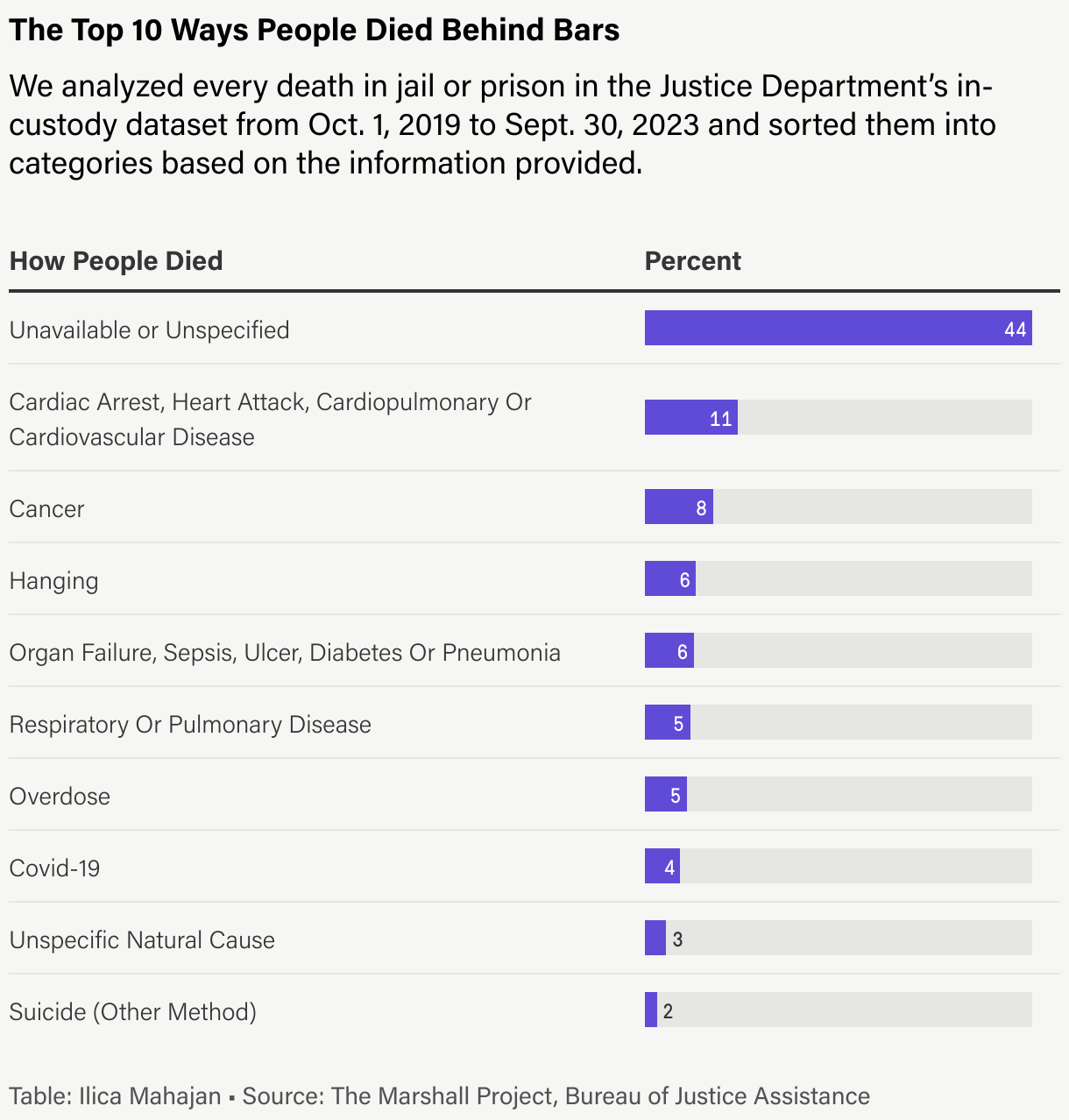
For cases where there was enough information to make a determination as to the cause of death, which constituted about 60 percent, we found the most common causes were related to heart conditions, followed by various types of cancer, and then respiratory conditions. These findings broadly align with mortality data for the entire U.S. population from the Centers for Disease Control and Prevention, which show heart disease as the leading cause of death in 2023, followed by cancer and then accidents.
For incarcerated people under the age of 55, just under half of the deaths we could identify were from largely preventable causes — like suicide or drug overdoses. Older incarcerated people tended to die from natural causes. In more than a third of cases, we simply could not determine a cause of death, because there was not enough information.
Our analysis is based on data collected by the Justice Department under the Death In Custody Reporting Act, which Congress passed a quarter-century ago with the intention of creating a record of everyone who dies in law enforcement custody.
Dr. Sharen Barboza, a psychologist who has worked in and around carceral facilities to reduce suicides for more than two decades, used to use previous iterations of this data that included fewer errors and more detailed information to benchmark different carceral jurisdictions against each other. But the data now released by the government, she said, isn’t particularly helpful, given the lack of detail.
“How can we decrease preventable death if we don’t even understand who's dying or why they're dying?” Barboza said.
Representatives from the Department of Justice did not provide an on-the-record comment for this story. However, the Justice Department does review the information sent to it by states to make revisions and, in a post on its website, “acknowledges ongoing reporting gaps and challenges that may affect the accuracy and completeness of ... [in-custody death] reporting.”
We acquired this dataset from a Department of Justice website presenting aggregate statistics for in-custody deaths. We were able to download the individual-level data, which was likely not intended to be released to the public, when it was inadvertently made accessible on the internet.
The data contained information like names, dates and brief descriptions of the circumstances surrounding each person who died in prisons, jails and during the course of arrest between Oct. 1, 2019 and Sept. 30, 2023.
Earlier this year, we published an analysis showing that the government’s data is riddled with errors. Not only did we find hundreds of deaths missing from the dataset, but the majority of the descriptions detailing how each person died didn’t meet the government’s own minimum quality standards.
Dr. Andrea Armstrong, a law professor at Loyola University New Orleans, whose research focuses on in-custody deaths, built her own databases in order to better understand who was dying behind bars and how. “I think data has to be the starting point,” Armstrong said. “If we don't have that information, then anything that we do is going to be uninformed and may, in fact, create more harm than good.”
Even so, the data can still be used to understand the broad ways in which people die in custody. Our analysis focused on the 21,675 people who died in prisons or jails, not those dying during the process of arrest.
Each record in the dataset contains a “Manner of Death,” which is a broad categorization, like “Natural Causes” or “Suicide.” The Justice Department annually reports aggregate counts of how many people died in each manner — representing the most comprehensive, publicly accessible, high-level picture. The data also contains a “Brief Circumstances” field describing what happened in more detail.
The Marshall Project used a series of artificial intelligence and machine learning algorithms — in conjunction with human verification — to gain a more accurate understanding of how people died in custody. We were able to identify when a death’s categorization did not reflect what was written in the “Brief Circumstances,” which happened in more than one-third of cases, to provide a potentially more accurate classification.
Read our in-depth methodology showing how we conducted our analysis.
Despite the increased detail provided by the “Brief Circumstance" field, there was not enough information in these descriptions to determine a cause of death in around 40% of cases. These deaths represented “Brief Circumstances” either left effectively blank, listed as “pending autopsy,” or simply stating, “Information not available.”
In many of these cases, we found a considerable number of deaths where the description noted insufficient evidence, but were labeled as suicides or deaths from “natural causes” without details or justification. About 2,140 of those were from California, which does not collect “Brief Circumstances” information, due to privacy concerns.
When we analyzed the incarcerated population by age, meaningful trends emerged.
While cardiac-related illnesses were the most frequent cause of death we could identify for those over 55, suicide was the leading cause in younger people. Cancer was responsible for the second most deaths for older people; overdoses or drug withdrawal complications came second after suicide for younger people. About half of the descriptions of drug-related deaths mentioned “fentanyl,” a synthetic opioid responsible for tens of thousands of overdose deaths across the United States every year.
For both men and women of all ages, cardiac incidents were the most common cause of death. Similarly, there was no difference for the most common cause of death for both Black and White incarcerated people. Around one-fifth of all identifiable deaths in the dataset were due to heart issues in each group.
People killing themselves is exceedingly common behind bars. Almost one-in-10 of the deaths in the dataset were suicides — making it the third most common way people of all ages died. While some suicides indicated intentional overdoses, hanging or asphyxiation were by far the most common methods, comprising almost three-quarters of suicide deaths.
Fatal violence between incarcerated people occurred with some regularity. More than 400 deaths were ruled homicides not involving law enforcement officials. There were fewer than 10 reported incidences of an officer's use of force resulting in death in the dataset. Many of those were due to blunt force trauma, choking or the use of a stun gun.
Executions were the least common way people died behind bars. The government only reported 18 such cases in the dataset and we found an additional three cases that had been mislabeled. This number is an undercount. Records from the Death Penalty Information Center show 70 people executed across the United States during the period covered by this dataset.
Mismatches between the “Manner of Death” listed and what was contained in an entry’s “Brief Circumstances” often followed consistent patterns.
There were more than 800 deaths with “Brief Circumstances” indicating COVID-19 as the cause. According to federal guidelines, COVID-19 deaths are supposed to be labeled as “Other”. We found less than one-fifth of those cases were categorized accurately. The majority were listed as “Natural Causes.”
Those guidelines state that the “Manner of Death” for a drug-related death, like from an overdose, should be also listed as “Other.” However, more than half of these deaths were incorrectly labeled as being accidental, which follows previous guidelines for this data collection that have since changed. In fact, of all 940 deaths originally listed as accidents, fewer than 100 warranted the label.
The quality problems abundant across the dataset are largely due to how it is constructed.
When someone dies while in custody, the official determination of a cause of death is typically made by a medical examiner or coroner using investigative techniques like autopsies, toxicology reports and interviews with guards or medical staff at the prison or jail.
Even at this stage in the process, inaccurate information can be introduced. For example, earlier this year, the deaths of dozens of people who died while being restrained by law enforcement were reclassified as homicides from their original designations of accidents or unknown, following a review of cases handled by a former Maryland medical examiner after an outcry over the examiner’s testimony as an expert witness in the murder case against the Minneapolis police officer who killed George Floyd.
Once an official designation is made, the information is given to the agency administering the prison or jail responsible for the incarcerated person when they die. From there, it is reported up to a state-level agency, which aggregates all of those reports, and, in turn, submits them to the Justice Department.
Since each state is left to its own devices, the reporting procedure can be disorganized and inconsistent.
In Florida, which lacks a law about tracking in-custody deaths, the state simply requests all local agencies to fill out an online form whenever they have a qualifying death. Jails across Mississippi do not report deaths at all. Washington, on the other hand, has laws requiring the collection of detailed death data following a state review of each death
The Bureau of Justice Assistance, the arm of the Justice Department responsible for administering the federal government’s in-custody death tracking, issues guidelines about what data to collect and how to classify deaths. Despite the agency’s power to issue fines to states that don’t follow those guidelines the agency has never penalized a state for sloppy or incomplete reporting.
Ultimately, Barboza said, Americans need to ask themselves a hard question: “Do we, as a country, care about those we incarcerate? Do we care? Do we care if they’re cared for? Do we care if they’re dying? Do we care how they die? Are we interested in decreasing those deaths?”
“And I think the sad answer,” she said, “is no one's all that interested in really understanding.”
An earlier version of this story misstated by one the number of people who were executed across the United States during the time period of our analysis.