Since President Donald Trump’s return to office, federal immigration agents have secretly detained people — cutting them off from lawyers and family — for hours, days and, in some cases, weeks, according to numerous media reports.
A man vanished for five days last December while Immigration and Customs Enforcement shuttled him through detention camps around the country, as The Marshall Project previously reported. By the time his family learned where he was, he’d been deported to Somalia.
A woman in Portland, Oregon, disappeared for about two weeks, reportedly held without charges or access to a lawyer while her family searched for her. A congresswoman finally located her at a Customs and Border Protection facility.
And this fall, ICE stopped publicly revealing the whereabouts of thousands of immigrants with final deportation orders, making it difficult for lawyers or family members to find them.
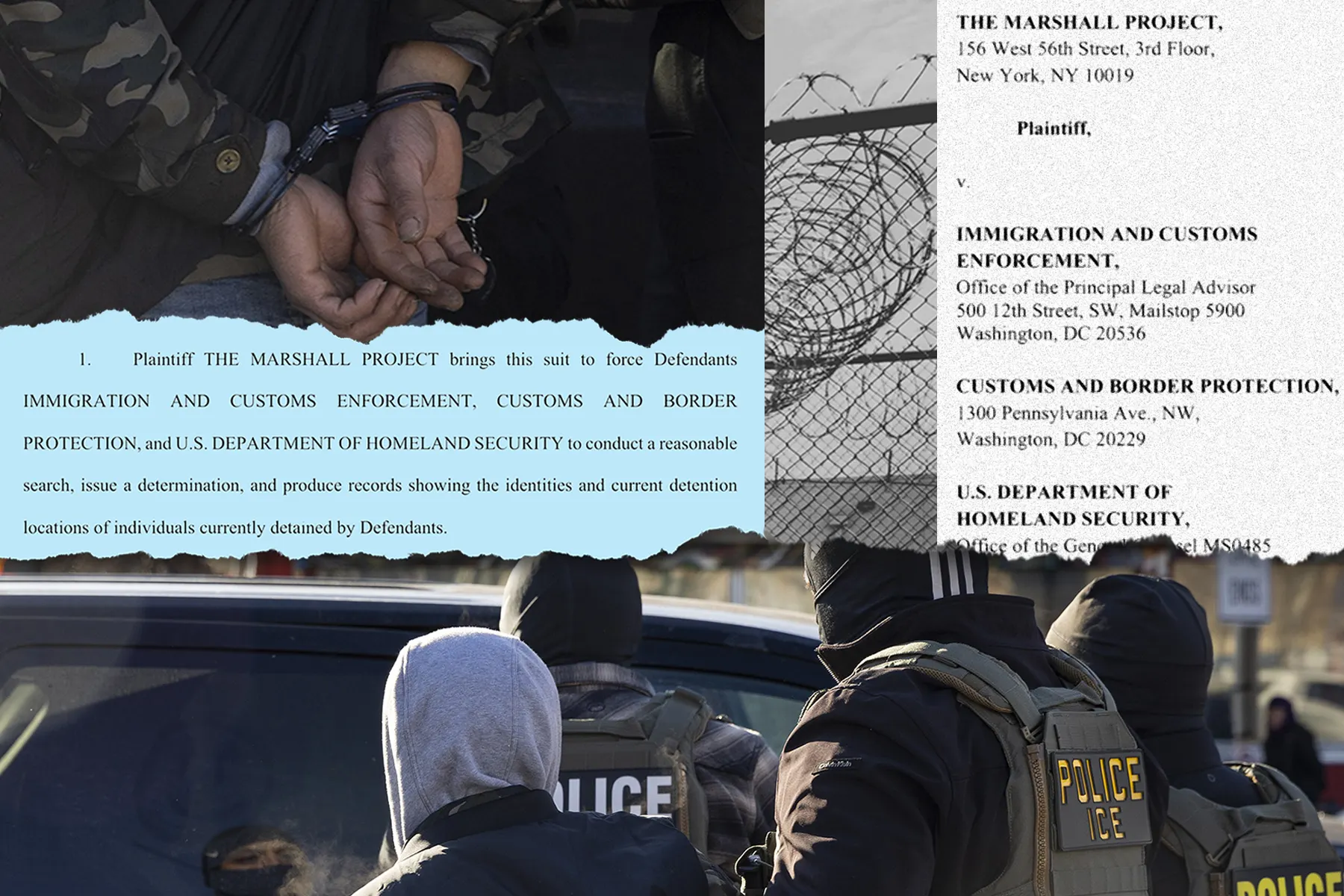
That’s why The Marshall Project on Tuesday filed a lawsuit against ICE and CBP in federal court to force the agencies to publicly disclose all the people in their custody. The suit, filed on The Marshall Project’s behalf by Chicago-based public-interest law firm Loevy & Loevy, seeks access to the names, ages and locations of everyone in ICE’s detention database.
We believe this to be the first lawsuit seeking access to the full database since Trump returned to the presidency. Though ICE maintains the database, other federal agencies engaged in immigration enforcement, including CBP, feed into it.
ICE rarely publicly reveals the identity of people it detains, and immigration attorneys have said the federal government sometimes ignores their requests for information on their clients. The agency maintains a searchable online locator, but attorneys and advocates say it’s often unreliable, not updated quickly enough and fails to include everyone in detention.
ICE’s operations contrast with local and state law enforcement. When police make an arrest, that person’s identity, criminal charges and detention location are made public in nearly every jurisdiction in the United States. Local jail rosters, including people’s names and ages, are routinely posted online.
Jennifer Peter, The Marshall Project’s editor-in-chief, said the nonprofit news organization filed the lawsuit to force ICE to conform to the same basic public disclosure and accountability as local police.
“We are seeking the same transparency and access to information that have existed within the criminal justice system for centuries. Detainees’ family members and those seeking to defend their rights deserve to know at least where they are being held,” Peter said. “To withhold that information in the name of privacy does not serve the best interest of the people whose privacy the government alleges to protect. It makes it far more difficult for their loved ones and attorneys to help them — and for organizations like The Marshall Project to shine a light on what’s truly happening within immigration camps and who’s being held there.”
ICE referred questions about the case to its parent agency, the Department of Homeland Security. Neither DHS or CBP immediately responded to requests for comment.
ICE has previously argued that publicly releasing names of people in detention would violate their privacy. “ICE recognizes the public interest in oversight of immigration enforcement and detention,” the agency wrote in an August response to The Marshall Project’s requests. “However, the request at issue seeks bulk disclosure of names, full dates of birth, and current detention locations for all entries. … The requested information implicates substantial privacy interests. Individuals have a strong privacy interest in avoiding public identification in law enforcement records, including immigration enforcement and detention records.”
The Marshall Project first submitted Freedom of Information Act (FOIA) requests in April to ICE and CBP for access to the names, dates of birth and current detention locations for all entries in ICE’s Enforcement Integrated Database, which contains records of detainees in the immigration system.
ICE and CBP denied the FOIA requests and subsequent administrative appeals. In its denials, ICE cited privacy protections in FOIA, including a provision that prevents release of federal law enforcement records if disclosure “could reasonably be expected to constitute an unwarranted invasion of personal privacy.”
When federal agencies deny requests and appeals for public information, the only remaining recourse is a lawsuit. Courts have previously allowed federal law enforcement agencies such as ICE to withhold names to protect people’s privacy, but those precedents are now being challenged in light of ICE’s recent operations.
The Marshall Project lawsuit follows a similar, though more narrow, case filed by Loevy & Loevy on behalf of Block Club Chicago, a local nonprofit media outlet, in federal court in Washington, D.C. Block Club requested the names and other details of people whom ICE detained during a 10-day span in Chicago in January 2025. ICE also denied that request. A federal district judge sided against Block Club in April, ruling that the privacy interests of people in detention outweighed the need for public disclosure. The case is currently on appeal with the U.S. Court of Appeals for the D.C. Circuit.
If Block Club prevails in its appeal, ICE could be forced to release information about the people detained in Chicago during that January 2025 period. The Marshal Project’s lawsuit seeks public disclosure of information about everyone ICE has detained nationwide.
The American Civil Liberties Union has weighed in on the Block Club case, arguing that allowing ICE and other federal law enforcement agencies to withhold the names of people they detain endangers democracy.
“Secret arrests have always been anathema in the United States,” the ACLU wrote in a court filing. “... For the two centuries that police departments have existed in this country, they have made arrest information open to the public. … Time and time again, despotic governments have weaponized secret arrests to suppress dissent and make public accountability impossible.”
The litigation follows ICE’s expansion and intensified immigration enforcement under Trump. Since January 2025, the agency has grown to more than 20,000 agents, making it one of the largest law enforcement entities in the country. Massive deployments to Los Angeles, Chicago and Minnesota resulted in thousands of arrests, a growing number of shootings — some fatal — and significant public backlash.
Since ending its surge in Minnesota in February, ICE has changed strategies. Instead of large urban deployments, its operations have become diffuse, detaining immigrants in communities across the country and relying often on cooperation from local law enforcement.
Immigrant detentions increased between March and July in nearly every state, The Marshall Project recently reported. Those figures only became public months later through the Deportation Data Project, which periodically obtains detention numbers from ICE. The data contains no names and only limited details about people ICE has arrested.