He Wrote a Song Called ‘Freedom.’ Now He’s Free.
Listen if you like: Sly and the Family Stone, Grover Washington Jr., Gil Scott-Heron
A few years ago, a group of men at a prison in Pennsylvania recorded “Songs in the Key of Free,” a concept album about mass incarceration with a title that evokes Stevie Wonder’s opus “Songs in the Key of Life.”
To close out our Redemption Songs series, I want to tell the story behind my favorite track, “Freedom,” because it feels to me like a parable of what music can do for people in prison and those of us on the outside. It’s the story of boys who grew up playing music before their lives took starkly different turns — one toward prison, the other toward fame — and they reunited musically decades later.
Bassist Bernard Lee grew up in Philadelphia in the 1950s with a who’s who of the city’s top musicians, including John Whitehead (of the songwriting duo McFadden & Whitehead), and Daryl Kwasi Burgee (a drummer who backed Patti LaBelle). As a teenager, he’d practice bass with his friend Jamaaladeen Tacuma. “When he first got his bass, I’d go over to his house on Saturdays and we’d shed,” Lee told me.
But by the late 1980s, Lee was at State Correctional Institution - Graterford, outside Philadelphia, serving life for murder. Tacuma had gone on to record and tour the world with free-jazz icon Ornette Coleman. “Jamaal was sending me pictures from Istanbul and other places he traveled,” Lee recalled.
In the meantime, Lee kept up his chops. Graterford had a famed music education program. In the 1970s, one of its bands, The Power of Attorney, even went off-site to open for Stevie Wonder. But such programs struggled to survive the rise of mass incarceration, as many Americans came to believe people who commit crimes don’t deserve access to the arts.
In 2002, the cable TV channel VH1 featured one Graterford band in a series called “Music Behind Bars.” TV news personalities from Bill O’Reilly to Katie Couric to Connie Chung attacked the channel and featured the mother of a young woman killed by one of the musicians. Pennsylvania Gov. Mark Schweiker shut down the program.
But by 2016, the political dynamics had changed and an English professor named August Tarrier started a small nonprofit called Songs in the Key of Free. She convinced the administration at Graterford to let her start a music program and allow men inside to collaborate with volunteer teachers from the Curtis Institute of Music.
The teachers told the Philadelphia Inquirer they came in expecting to teach beginners, but found out some of the incarcerated men, like Lee, were virtually professionals. The men wrote and recorded songs about policing and mass incarceration, with titles like “Million Dollar Blocks” and “I Can’t Breathe.”
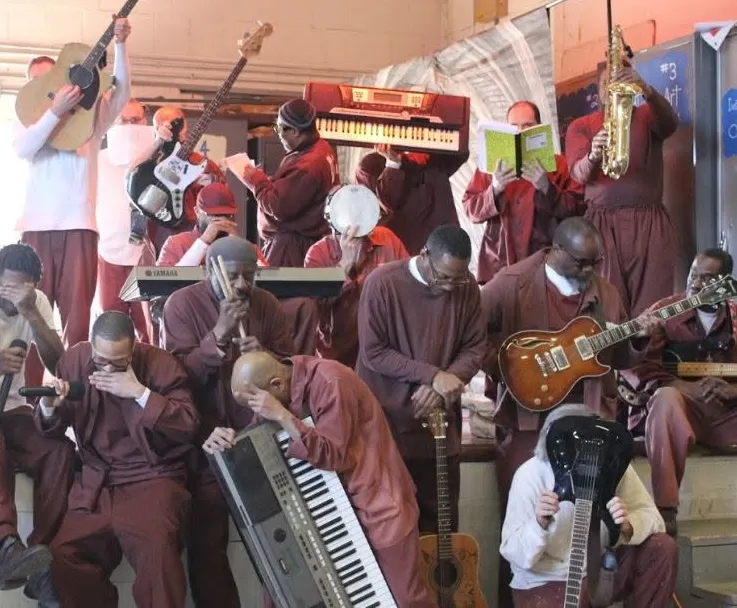
In this community, Lee emerged as “our Mr. Rogers, our town crier,” as Tarrier put it in a Facebook post. He told the volunteers about some of his childhood friends, and the volunteers organized a musical reunion. They brought a recording crew into the prison, where Lee and several other musicians recorded the spine of “Freedom.”
Then Lee’s friends gathered at an outside studio to play their own parts and stitch it together in editing. At the top of the track, Lee’s friend Lawrence “Weas” Newton seems to address Bernard: “You weren’t physically free, but your soul could be. Your soul can always be free.”
“He said what I was feeling,” Lee told me. “It was freaky when I heard that.”
“Freedom” itself is not quite free jazz, but it refuses easy genre labels. Lee and Tacuma’s basses are both prominent during the instrumental first half of the song, as if they’re conversing with each other. The tick-tock drum beat feels like a metaphor, reflecting the idea of serving time, until the band bursts into a faster groove and Newton lets loose on lines like, “Let my soul be free!” and, “I’m comin’ home!”
“It felt like the musicians on the outside were channeling Bernard, invoking his presence, casting a spell for his freedom,” Tarrier told me. “It felt like we were jumping over the prison wall.”
This album captures a fleeting moment in the long struggle to keep music going behind bars. In 2018, Graterford prison was shut down and all the men there were transferred to a new facility called SCI-Phoenix, where Songs in the Key of Free was not allowed in, so the album had to be finished in outside studios.
But a few weeks ago, while I was working on this piece, Tarrier called me with surprising news: Lee was granted parole. He had applied with letters of support from Tarrier and his musician friends.
“It was nerve-racking, waiting, getting my hopes up,” Lee told me. The last step was a signature from Pennsylvania Gov. Josh Shapiro. “When I heard the governor signed for my release, I broke down, I was hysterical.” He’s 73 years old, but was able to see his mother, who is 100 and reportedly had said, “I ain’t goin’ to my maker until Bernard comes home.”
On one of his first days out, he went to see his friends perform. He expects soon they’ll invite him up onstage.
LINER NOTES
Song: “Freedom” | Album: “Songs in the Key of Free” | Release date: Dec. 2, 2022 | Songwriter: Bernard Lee | Bass: Bernard Lee (incarcerated) | Keys: Darrell Jones (incarcerated) | Drums and Saxophone: Rashied Frazier (incarcerated) | Congas: James Alderman (Kabir) (incarcerated) | Philadelphia Recording Session Produced by: Jamaaladeen Tacuma for JAM-ALL PRODUCTIONS | Recorded at: Retro City Studios, Philadelphia | Music Arranged by: Jamaaladeen Tacuma, Daryl Burgee, Bobby Zankel, Sumi Tonooka | Vocal Arrangements: Jamaaladeen Tacuma, Lawrence Weas Newton | Bass Guitar: Jamaaladeen Tacuma | Drums, Congas: Daryl Burgee | Rhodes Piano: Sumi Tonooka | Alto Saxophone: Bobby Zankel | Vocals: Lawrence “Weas” Newton | Recording Engineer: Brendan McGeehan